
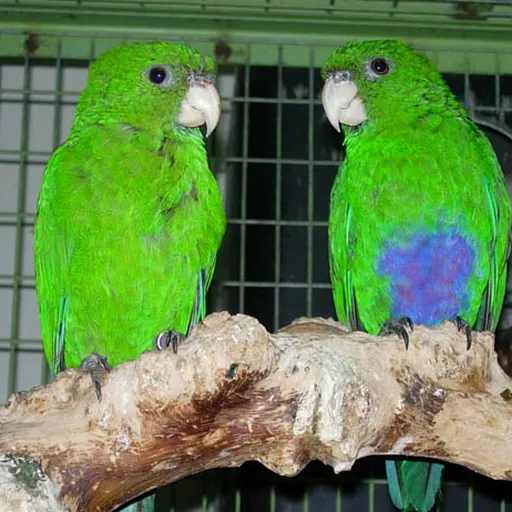
Blue-bellied Parrot
Triclaria malachitacea
Least Concern
Overview
The blue-bellied parrot (Triclaria malachitacea) is the only species in its genus and is generally considered endemic to the humid Atlantic Forest of southeastern Brazil. Although classified as Least Concern by the IUCN, its population is dwindling due to habitat loss, and it is now mostly restricted to remnant forest strips on slopes and ridges.
Identification
- Relatively long-tailed parrot with a total length of c. 28 cm.
- Green overall plumage with a whitish beak.
- Only the male displays the bluish-purple patch on the belly for which the species is named.
- Possesses a whistled call, with pairs often singing in duet, though the bird is typically quiet and easily overlooked.
Habitat
The species is generally considered endemic to the humid Atlantic Forest of southeastern Brazil, occurring up to 1000 m in elevation. It is now mostly restricted to remnant forest strips on slopes and ridges, which cover far less than 10% of its original range, with two unconfirmed records from Misiones in Argentina.
Diet
The blue-bellied parrot has been recorded feeding on seeds, fruits, flower buds, nectar, and some insects. Its nest is placed in the cavity of a large tree or palm, and the pair is highly territorial during the breeding season.
Did you know?
While originally believed that only 5,000–10,000 birds survived across their range, recent evidence suggests that c. 10,000 survive in the state of Rio Grande do Sul alone. Fair numbers of the birds reached the Netherlands in the 1970s and 1980s, although the cage-bird trade is not currently considered a major threat.
Sources
- Wikipedia · CC BY-SA 4.0
- Wikidata · CC0 1.0