
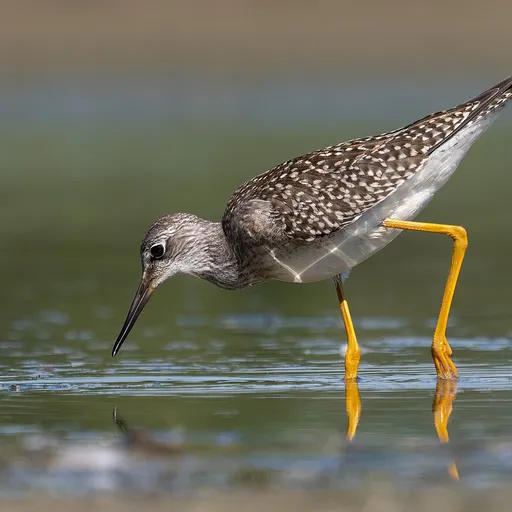
Lesser Yellowlegs
Tringa flavipes
Vulnerable
Listen
XC934273 · Doug Hynes · Landing Lake, Churchill, MB, Canada · CC BY-SA 4.0
Overview
The lesser yellowlegs is a medium-large shorebird classified as Vulnerable on the IUCN Red List. It breeds in the boreal forest region of North America and winters from the south of North America to the far south of South America.
Identification
- Medium-large shorebird measuring 23–25 cm in length with a wingspan of 59–64 cm.
- Legs are distinctly yellow; the bill is short, slim, straight, and uniformly dark, appearing visually about the same length as the head.
- Breeding plumage features mottled grey-brown, black, and white upperparts, with white underparts and irregular brown streaking on the breast and neck; non-breeding plumage has more uniform grey-brown upperparts.
- Call is softer than that of the greater yellowlegs.
Habitat
Breeding habitat consists of clearings near ponds in the boreal forest region from Alaska to central Quebec, primarily between 51° and 69° N latitude. During winter, the species is widely distributed in Mexico, Central America, South America, and the Antilles, often found in coastal regions and intertidal mudflats.
Diet
This bird primarily eats invertebrates such as flies, beetles, water boatmen, and mayflies, along with small fish, crustaceans, aquatic worms, molluscs, spiders, and seeds. It forages in shallow water or on land using a high-stepping gait, sometimes probing into mud or sweeping its bill through water, and occasionally forages at night.
Did you know?
The lesser yellowlegs is a regular vagrant to western Europe, with approximately five birds arriving in Great Britain each year, mostly between August and October.
Sources
- Wikipedia · CC BY-SA 4.0
- Wikidata · CC0 1.0