
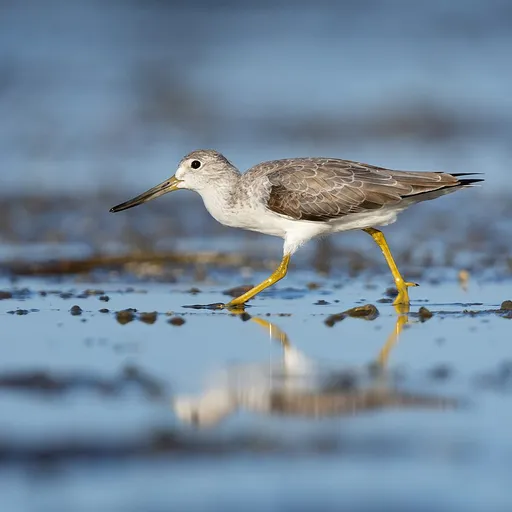
Nordmann's Greenshank
Tringa guttifer
Endangered
Overview
Nordmann's greenshank is a medium-sized wader in the family Scolopacidae that is currently classified as Endangered on the IUCN Red List. It is primarily found within the East Asian-Australasian Flyway, where a wild population of 1500 to 2000 individuals persists as of 2023.
Identification
- Medium-sized sandpiper, 29–32 cm long, with a slightly upturned, bicoloured bill and relatively short yellow legs.
- Breeding adults feature darker plumage with dark brown spangling on the back, chest, and head, a white underbelly, and broad, blackish, crescentic spots on the lower neck and breast.
- Non-breeding adults display lighter brown to gray plumage on the back with minimal spotting on the neck and chest.
- Breeding adult bills are darker and less obviously bicoloured compared to non-breeding adults.
Habitat
Breeding populations are located in eastern Russia along the south-western and northern coasts of the Sea of Okhotsk and on Sakhalin Island, with a strong preference for partially dried boglands containing stands of larch trees. Significant numbers occur during migration in South Korea, mainland China, Hong Kong, and Taiwan, while wintering grounds include Bangladesh, Thailand, Cambodia, Vietnam, and Peninsular Malaysia. The species has also been recorded in Japan, North Korea, India, Sri Lanka, Myanmar, Singapore, the Philippines, Indonesia, and occasionally on the east coast of Australia.
Did you know?
The eggs of the Nordmann's greenshank are pale blue-green with darker gray to brown speckling that condenses near the widest end, a colouration described as being similar to the eggs of the North American Blue Jay.
Sources
- Wikipedia · CC BY-SA 4.0
- Wikidata · CC0 1.0