
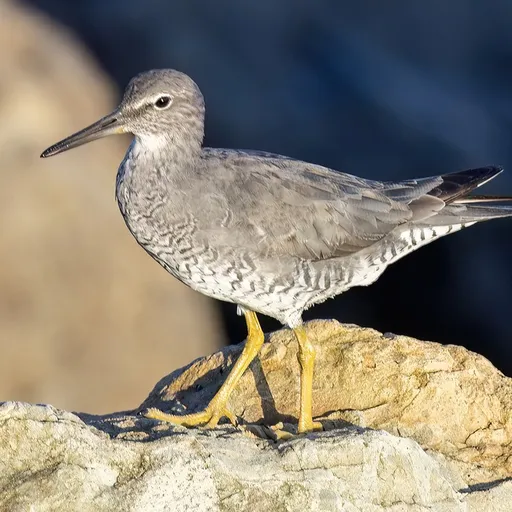
Wandering Tattler
Tringa incana
Least Concern
Overview
The wandering tattler (Tringa incana) is a medium-sized shorebird classified as Least Concern on the IUCN Red List. It is similar in appearance to the closely related gray-tailed tattler but is distinct among Tringa species for its unpatterned, greyish wings and backs. The species is monotypic, with no recognised subspecies.
Identification
- Size: Length of 26–30 cm, weight of 60–169 g, and wingspan of 50–55 cm.
- Plumage: Stocky body with gray upperparts, underwings, face and neck, and a white belly; adults in breeding plumage are heavily barred underneath.
- Features: Short dark yellow legs and a dark gray bill, with a prominent supercilium in breeding plumage.
- Vocalisation: A rapid trill of accelerating, staccato notes, consisting of three or four beats per call.
Habitat
In summer, the species breeds in far-eastern Russia, Alaska, portions of the California coast and northwestern Canada, nesting in rocky areas along mountain streams. Outside the breeding season, it is well distributed throughout the Pacific, frequenting coastlines and isolated rocky islands from California to South America and as far as Australia.
Diet
The wandering tattler feeds on aquatic invertebrates such as crustaceans and marine worms, supplementing its diet with insects during the breeding season. While wading, it forages actively using jerky bobbing movements and may repeatedly return to the same location over short periods.
Did you know?
The specific epithet incana is derived from the Latin word meaning 'light gray' or 'hoary', reflecting the bird's colouration.
Sources
- Wikipedia · CC BY-SA 4.0
- Wikidata · CC0 1.0