
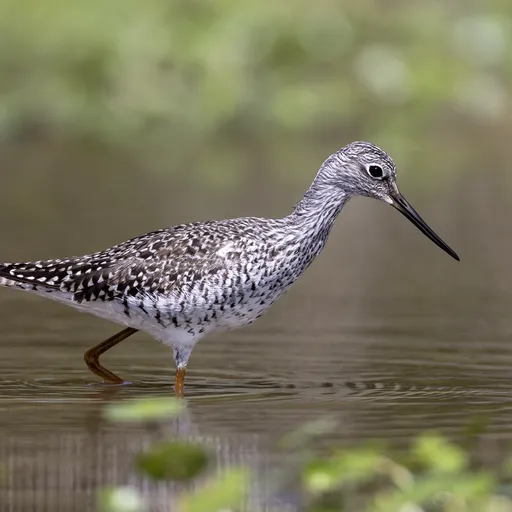
Greater Yellowlegs
Tringa melanoleuca
Near Threatened
Listen
XC613398 · Doug Hynes · Terra Nova (Village), Newfoundland and Labrador, Canada · CC BY-SA 4.0
Overview
The greater yellowlegs is a large shorebird in the family Scolopacidae that breeds in central Canada and southern Alaska. It is currently classified as Near Threatened on the IUCN Red List.
Identification
- Adults feature long yellow legs and a long, thin, dark bill that is slightly upturned and longer than the head.
- The body is grey-brown above and white below, with a white rump and dark brown streaking on the neck and breast.
- It is 29–40 cm long with a wingspan of 60 cm.
- The call is a harsh, loud, and clear three-syllable whistle, with the third syllable pitched lower than the others.
Habitat
This species breeds in bogs and marshes within the boreal forest region of Canada and Alaska. It migrates to the Atlantic and Pacific coasts of the United States, the Caribbean, and South America, though it is a very rare vagrant to western Europe.
Diet
Greater yellowlegs forage in shallow water, sometimes using their bills to stir up the substrate. They feed primarily on insects, small fish, crustaceans, and marine worms, but also consume frogs, seeds, and berries.
Did you know?
The species was initially misidentified by early naturalists as a 'stone snipe', a name coined by John Latham and Thomas Pennant based on a bird observed feeding in Chateau Bay, Labrador in 1785.
Sources
- Wikipedia · CC BY-SA 4.0
- Wikidata · CC0 1.0