
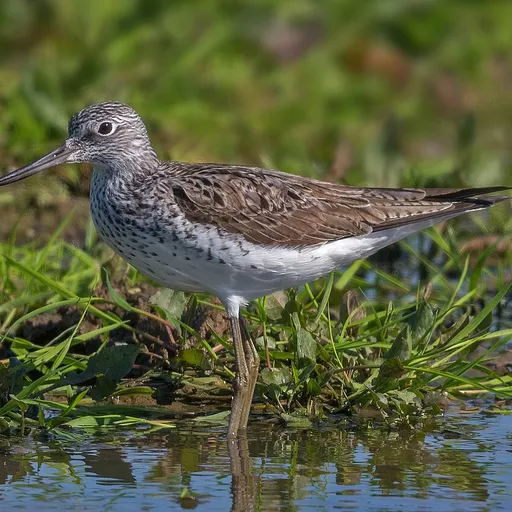
Common Greenshank
Tringa nebularia
Least Concern
Listen
XC1107766 · Sonothèque ADVL · Cabane Vauban (near Carolles), Manche, Normandie, France · CC0 1.0
Overview
The common greenshank is a wader in the large family Scolopacidae that breeds in subarctic regions across northern Europe and the Palearctic. It is a migratory species that winters in Africa, the Indian subcontinent, and Australasia, typically on fresh water.
Identification
- Brown in breeding plumage and grey-brown in winter, somewhat larger than the related common redshank.
- Long greenish legs and a long bill with a grey base, which appears upturned due to the shape of the lower bill.
- Displays a white wedge on the back in flight.
- The usual call is a rapid series of three short fluty notes syllabified as teu-teu-teu.
Habitat
A subarctic bird that breeds from northern Scotland eastwards across northern Europe and east across the Palearctic. It breeds on dry ground near marshy areas, laying about four eggs in a ground scrape, and winters usually on fresh water.
Diet
Like most waders, they feed on small invertebrates, but will also take small fish and amphibians.
Did you know?
The specific epithet nebularia is derived from the Latin word for mist, referring to the bird's damp marshy habitat. In 2024, Tringa nebularia was listed as Endangered under the Australian EPBC Act, despite its global status of Least Concern on the IUCN Red List.
Sources
- Wikipedia · CC BY-SA 4.0
- Wikidata · CC0 1.0