
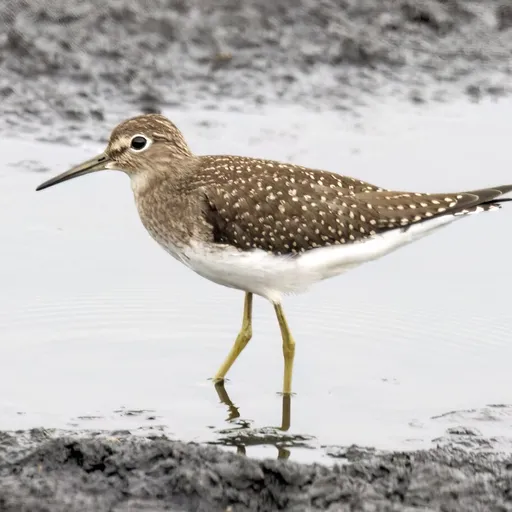
Solitary Sandpiper
Tringa solitaria
Least Concern
Overview
The solitary sandpiper (Tringa solitaria) is a small shorebird that belongs to the genus Tringa. It is classified as Least Concern on the IUCN Red List and is distinguished by its solitary nature, usually being seen alone during migration.
Identification
- Plumage: Dumpy wader with a dark green back, greyish head and breast, and white underparts.
- Flight: Wings are dark above and below, featuring a dark rump and tail centre that distinguishes it from the green sandpiper.
- Sound: Emits a characteristic three-note whistle in flight.
Habitat
It breeds in woodlands across Alaska and Canada, with subspecies ranging from western Canada to Labrador. This migratory species winters in Central and South America, particularly in the Amazon River basin, and the Caribbean. It is a very rare vagrant to western Europe in summer and fall.
Diet
It forages for small invertebrates such as insects, crustaceans, and molluscs, occasionally taking small frogs or tadpoles. The bird picks these off the mud while working steadily around the edges of its chosen pond, often in sites like ditches that are too restricted for other waders.
Did you know?
Unlike most other scolopacids, this species nests in trees, specifically by laying a clutch of 3–5 eggs in abandoned nests of songbird species such as thrushes.
Sources
- Wikipedia · CC BY-SA 4.0
- Wikidata · CC0 1.0