
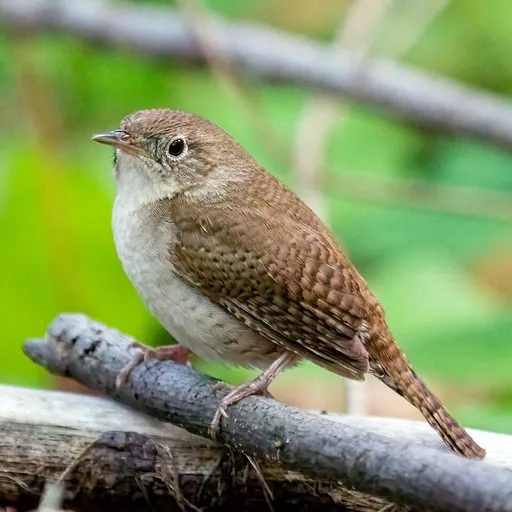
Northern House Wren
Troglodytes aedon
Least Concern
Listen
XC663297 · David Rojas · Tapachula de Córdova y Ordoñez, Tapachula, Chiapas, Mexico · CC0 1.0
Overview
The northern house wren (Troglodytes aedon) is a very small passerine bird found in southern Canada, the United States and Mexico. It is commonly present in most suburban areas within its range and is currently classified as a species of Least Concern on the IUCN Red List.
Identification
- Length of 11 to 13 cm with a wingspan of 15 cm and a weight of 10 to 12 g.
- Upper parts range from dull greyish-brown to rich rufescent-brown, while underparts vary from brown, buff or pale grey to pure white.
- Features blackish barring on the wings and tail, a faint eye-ring and eyebrow, and legs that are pinkish or grey.
- Possesses a long, thin bill with a blackish upper mandible and a black-tipped yellowish or pale grey lower mandible.
- Short tail is typically held cocked.
- Rich bubbly song is commonly heard during the nesting season but rarely afterwards.
Habitat
This species inhabits southern Canada, the USA and Mexico, occurring in most suburban areas within its range. It achieves its highest density in floodplain forests in the western Great Plains, where it often uses woodpecker holes for nesting. Migrants winter in the southern United States and Mexico.
Diet
The bird forages actively in vegetation and mainly eats insects such as butterfly larvae, beetles and bugs, as well as spiders and snails. Southern house wrens rarely attend mixed-species feeding flocks.
Did you know?
The scientific name troglodytes means 'hole dweller', referring to the bird's tendency to disappear into crevices when hunting insects or seeking shelter.
Sources
- Wikipedia · CC BY-SA 4.0
- Wikidata · CC0 1.0