
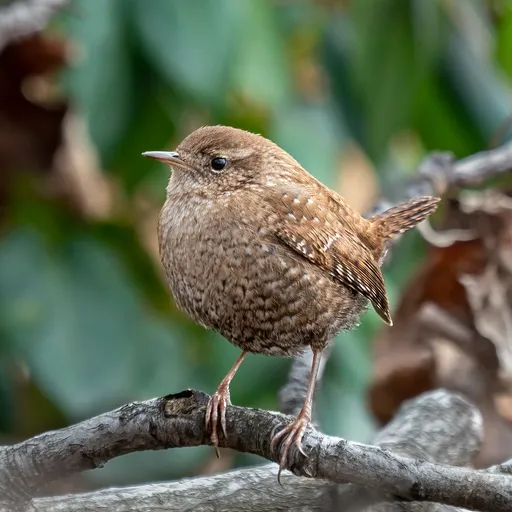
Winter Wren
Troglodytes hiemalis
Least Concern
Listen
XC920776 · Doug Hynes · Seal Island, Nova Scotia, Canada · CC BY-SA 4.0
Overview
The winter wren (Troglodytes hiemalis) is a very small North American bird belonging to the wren family Troglodytidae. Formerly grouped with the Eurasian wren and Pacific wren under the name northern wren, it was recognised as a separate species in 2010. It is classified as Least Concern on the IUCN Red List.
Identification
- A small brown ball due to a short neck and a tail often cocked above the back, measuring 8–12 cm in length.
- Plumage is rufous brown above and grayer below, barred with darker brown and gray, including on the wings and tail.
- Features a dark brown bill, pale brown legs, and most individuals have pale 'eyebrows' over their eyes.
- Often identified in coniferous forests by its long and exuberant song.
Habitat
The species breeds in coniferous forests from British Columbia to the Atlantic Ocean, with a preference for spruce and fir. It migrates through and winters across southeastern Canada, the eastern half of the United States, and rarely in north-eastern Mexico.
Diet
Primarily an insectivore, it eats arthropods with a preference for spiders, caterpillars, adult beetles, and flies. Less common food items include mites, ticks, bees, wasps, ants, centipedes, millipedes, and amphipods. It forages on substrates such as bark and fallen logs, allowing it to survive in moderately cold and even snowy climates.
Did you know?
The genus name Troglodytes derives from the Greek words for 'cave-dweller', reflecting the bird's tendency to roost in dark retreats, snug holes, and old nests, sometimes in groups during hard weather to stay warm.
Sources
- Wikipedia · CC BY-SA 4.0
- Wikidata · CC0 1.0