
Citreoline Trogon
Trogon citreolus
Least Concern
Overview
The citreoline trogon (Trogon citreolus) is a bird species in the family Trogonidae endemic to western Mexico. It has a very large estimated distribution size of 539,000 km², leading the IUCN to classify it as a species of Least Concern with a stable population trend.
Identification
- Approximately 27 cm in length and weighing between 85 and 90 grams.
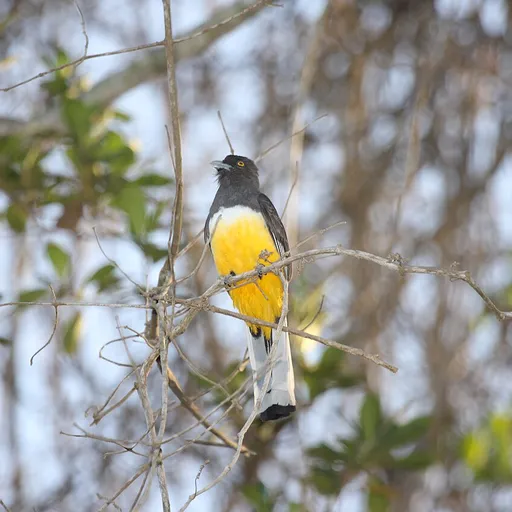
- Adult males feature a uniform gray head and upper breast, a metallic green mantle fading to a violet-blue rump, and a bright yellow belly separated by a creamy white breastband.
- The bill is pale blue-grey with yellow eyes; wings are dark with white outer webs on the primaries.
- Females are entirely dark gray above with a paler gray breast and paler yellow belly.
- Voice is a rapid sequence of low, throaty, short notes resembling an antbird.
Habitat
Natural habitats include arid or semi-arid woodlands, low coastal jungle, thorny brushland, thorn-forest, mangroves, and plantations. The species has two subspecies: T. c. citreolus on the Pacific slope of Mexico from Sinaloa to Oaxaca, and T. c. sumichrasti on the Pacific coastal plain of Oaxaca and Chiapas.
Diet
Diet shifts seasonally, with mainly fruit consumed from January to June and insects from July to November, though both are eaten in December and January. Insects are caught whilst hovering at the end of long upward or outward darts, including dragonflies, mantises, grasshoppers, and caterpillars. Fruit is often swallowed with the seed, which is later regurgitated.
Did you know?
The citreoline trogon acts as an ecosystem engineer by nesting in cavities within arboreal termitaria (termite nests built in trees). This nesting behaviour creates necessary cavities for many other organisms in tropical dry forests.
Sources
- Wikipedia · CC BY-SA 4.0
- Wikidata · CC0 1.0