
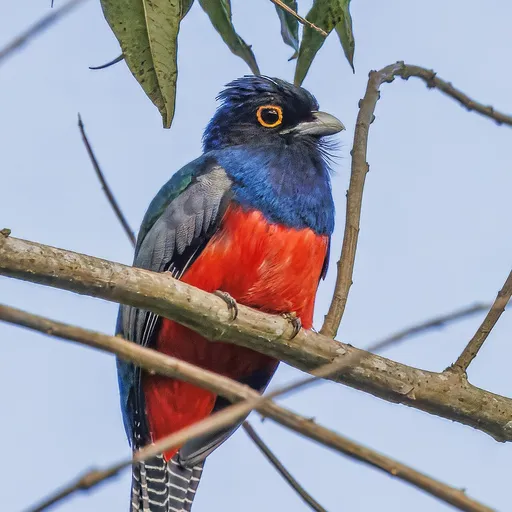
Blue-crowned Trogon
Trogon curucui
Least Concern
Overview
The blue-crowned trogon (Trogon curucui) is a species of bird in the family Trogonidae, found across parts of South America. As with all trogons, this species is sexually dimorphic, with distinct plumage differences between males and females.
Identification
- Males of the nominate subspecies feature a glossy greenish-blue head, turquoise-green nape, and metallic bronzy green back, with a red belly separated by a narrow white breastband.
- Females have a grey head and back with a pinkish-red belly, distinguished from males by broken white eye-rings instead of orange.
- Approximately 24 cm long, the male's song is a fast, evenly paced repetition of 'kow' notes lasting 4-5 seconds, ending abruptly.
- Both sexes produce a 'churrr' call.
Habitat
Found throughout the Amazon Basin south of the Amazon River and extending east and south, the blue-crowned trogon inhabits a variety of landscapes including forests, savanna woodlands, and scrublands. It occupies all levels from the understory to the canopy and typically stays below 500 m in the north but reaches higher elevations in southern parts of its range.
Diet
The blue-crowned trogon consumes a wide variety of insects and spiders, as well as fruits. It occasionally joins mixed-species foraging flocks to obtain food.
Did you know?
The common name and scientific name derive from 'Surucui', a word from the extinct Brazilian Tupi language for a small bird, which was first described in 1648 by German naturalist Georg Marcgrave.
Sources
- Wikipedia · CC BY-SA 4.0
- Wikidata · CC0 1.0