
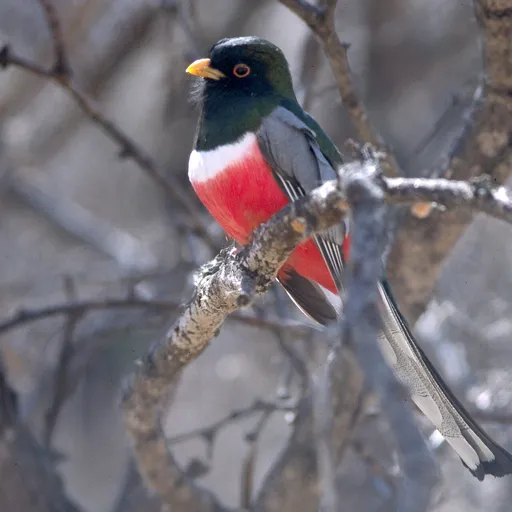
Elegant Trogon
Trogon elegans
Least Concern
Overview
The elegant trogon (Trogon elegans) is a medium-sized bird in the trogon family native to Central America. Formerly considered conspecific with the coppery-tailed trogon, it is the northernmost trogon species in the world alongside the eared quetzal. It is currently listed as Least Concern on the IUCN Red List.
Identification
- Males display a red-orange lower chest and belly with a metallic deep green back, a black face and throat, a white chest band, grey upperwings, and a long square-tipped tail that is brown above and white with black horizontal stripes below.
- Females and immature males resemble mature males in pattern but possess duller brownish-grey plumage and a white ring around the eyes.
- The bird is medium-sized, measuring 28–30 centimetres long and weighing between 60 and 78 grams.
- Calls consist of a croaking "co-ah co-ah co-ah" with occasional chattering notes, with males being more vocal than females.
Habitat
Endemic to Central America, the species ranges from Guatemala north to the mountains of southeast Arizona. It inhabits lower levels of semi-arid open woodlands and forests, favouring dry, arid environments such as pine, deciduous, and second-growth forests on hillsides near cliff edges. In Arizona, it is found in canyons with riparian and edge vegetation, including junipers, oaks, and sycamores.
Diet
The elegant trogon is frugivorous and insectivorous, consuming fruits such as grapes, cherries, figs, chokecherry, and buckthorn, alongside insects like grasshoppers, mantids, caterpillars, moths, and beetles. It occasionally preys on small vertebrates, usually lizards. To capture insects, it remains motionless on a perch before jumping into flight, while hovering over berries to pluck fruits.
Did you know?
Tail movement serves as a form of communication, where raising the tail can signal dominance, aggression, mating status, or act as an alarm to deter predators. Despite their fast flight, the birds are reluctant to fly any distance and typically perch upright and motionless.
Sources
- Wikipedia · CC BY-SA 4.0
- Wikidata · CC0 1.0