
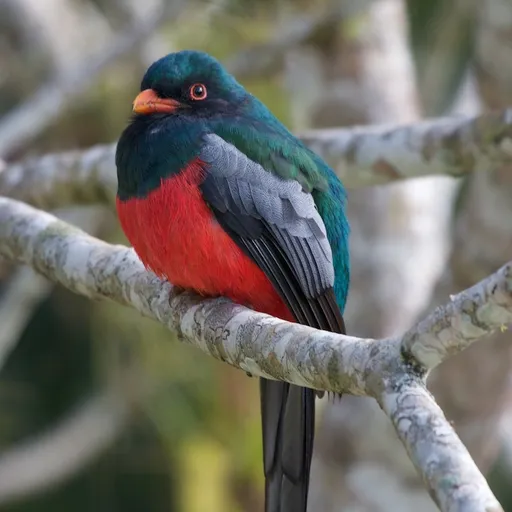
Slaty-tailed Trogon
Trogon massena
Least Concern
Overview
The slaty-tailed trogon (Trogon massena) is a species of bird in the family Trogonidae found across the Americas. It comprises three recognised subspecies and is currently assessed by the IUCN as being of Least Concern due to its large range and stable population.
Identification
- Males feature an orange-red bill, a dull black face with a red to orange eye-ring, and metallic green upperparts that shift to golden green on the back.
- The belly and vent are deep red, while the folded wings appear gray at a distance due to fine black and white vermiculation.
- Tail feathers show metallic green to bronzy green uppersides with black tips in males, but slate gray undersides in both sexes.
- Females resemble males but replace the green plumage with gray and possess a dusky gray maxilla.
- The song is described as a steady, deliberate series of deep, full-throated 'wuk' notes, accompanied by quiet clucking calls.
Habitat
The species primarily inhabits the midstory to the canopy of tropical evergreen and mature secondary forests, though it also occurs in gallery forests, coffee plantations, and mangroves. It is a bird of the lowlands, generally reaching 600 m in Mexico and northern Central America, but locally ascending to 1,400 m in Panama. Its range extends from southern Mexico through Central America into Colombia and Ecuador.
Diet
The slaty-tailed trogon feeds on fruits and insects by sallying or hover gleaning from a perch. It frequently follows white-faced capuchin monkeys to capture insects displaced by the primates.
Did you know?
Nest building is a collaborative effort where both sexes excavate the nesting chamber, typically high up to 15 m in a cavity within an occupied termite nest or decaying tree trunk.
Sources
- Wikipedia · CC BY-SA 4.0
- Wikidata · CC0 1.0