
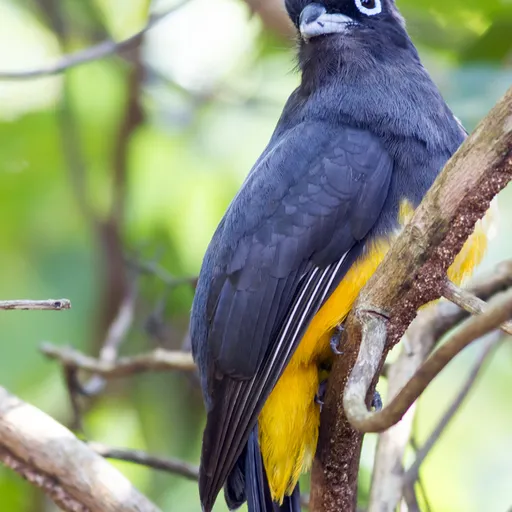
Black-headed Trogon
Trogon melanocephalus
Least Concern
Overview
The black-headed trogon (Trogon melanocephalus) is a species of bird in the family Trogonidae found across the Caribbean and Pacific slopes of Central America. It is considered common in most of its range and is more flexible in its habitat requirements than other trogons, tolerating degraded forests and human-managed landscapes.
Identification
- Adults of both sexes have a slate-black to black head, neck, and chest, with a sky-blue ring of bare skin surrounding the dark eye.
- A thin white line separates the black chest from the cadmium to chrome yellow underparts, which become lighter at the vent area.
- Adult males have bright metallic bluish-green to golden-green upperparts, whereas adult females have dark slate upperparts.
- The species is vocal, often detected by a loud series of 15–20 accelerating clucks or 'cuck' notes, sometimes performed as a duet or by small groups.
Habitat
The species inhabits a variety of forest types including wet and moist tropical forest, pinelands, gallery forest, secondary forest, and dry forest, favouring forest edges over dense interiors. It also occurs in semi-open landscapes such as banana and cacao plantations, gardens, and suburban areas, typically between sea level and 600 m but occasionally up to 1,000 m. Its range extends from southern Veracruz in Mexico south to central Nicaragua on the Caribbean slope, and from El Salvador through to northwestern Costa Rica on the Pacific slope.
Diet
The adult diet consists of fruit and arthropods collected while hovering after short sallies from a perch, with the bird returning to the perch to eat. Nestlings are fed arthropods almost exclusively, especially larvae. Foraging typically occurs from the mid-story to the canopy, often along forest edges and in gaps.
Did you know?
All known nests of the black-headed trogon are located in the active termitaria of Nasutitermes termites. Both sexes excavate the nest cavity, which can range in height from near the ground to 5 m up.
Sources
- Wikipedia · CC BY-SA 4.0
- Wikidata · CC0 1.0