
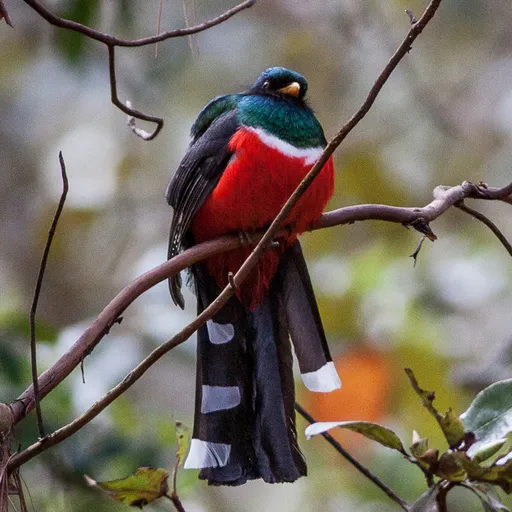
Mountain Trogon
Trogon mexicanus
Least Concern
Overview
The mountain trogon, or Mexican trogon (Trogon mexicanus), is a species of bird in the family Trogonidae first described by William Swainson in 1827. It is resident in Guatemala, Honduras, and Mexico, with occasional vagrant records in El Salvador and Nicaragua.
Identification
- Males feature a metallic green crown, nape, upperparts, and chest, contrasting with a bright red belly and vent separated by a narrow white band.
- Females are warm brown on the head and upperparts with a small white crescent in front of the eye and a bold white crescent behind it, also showing a red belly separated from the brown chest by a white band.
- Measures 11.5–12.5 in (29–31.5 cm) in length and weighs between 61.5 and 85 g, with a bright yellow bill in males and a dark bill in females.
- Vocalisations include a sharp, low-pitched 'cut' or 'tuck' when alarmed, a quick 'cut-a-cut-cut' in flight, and a slow, repetitive 'cowh' or 'tucka-tucka-tucka' when perched.
Habitat
This species inhabits subtropical and tropical moist montane forests, preferring pine-evergreen and pine-oak woodlands at elevations between 3,000 and 10,000 ft (914 and 3,048 m). It shows some adaptability to human land use, utilising coffee plantations with suitable shade trees like oaks.
Diet
The mountain trogon feeds on insects and small fruits, which it catches or plucks while on the wing. It may associate with mixed-species flocks, moving through the upper and middle levels of the forest.
Did you know?
As a cavity nester, the mountain trogon uses its beak to gnaw holes in rotting wood, such as decaying stumps or branches, to create its own nest cavities, though it also uses cavities made by large woodpeckers. The genus name Trogon is a Greek word meaning 'grawing' or 'nibbling', likely referencing this nesting behaviour.
Sources
- Wikipedia · CC BY-SA 4.0
- Wikidata · CC0 1.0