
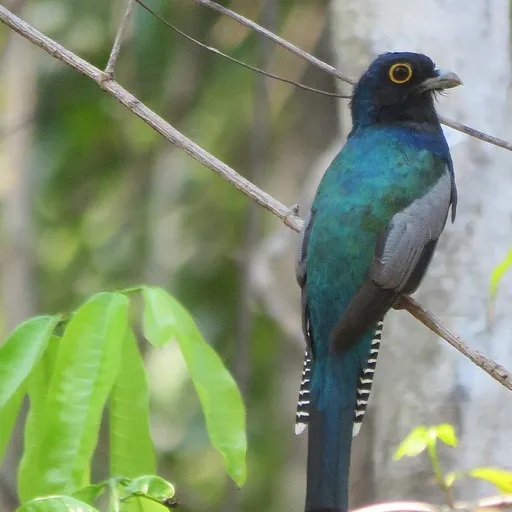
Amazonian Trogon
Trogon ramonianus
Overview
The Amazonian trogon (Trogon ramonianus) is a species of bird in the family Trogonidae, found across parts of South America. It was recently split from the violaceous trogon by several major taxonomic authorities, though others still treat it as a subspecies.
Identification
- Size: Approximately 23 to 25 cm in length, with males weighing 44 to 46 g.
- Plumage: Males feature deep metallic blue-black heads and upper breasts, bright yellow lower breasts, and metallic green upperparts; females are dark gray on the head and upperparts with a duller yellow belly.
- Markings: Males have a narrow white band separating the blue-black upper breast from the yellow belly, and a deep blue tail upperside with black feather tips.
- Song: A relatively short, rapid series of clipped cow notes, or 'mewing whistles', accompanied by rolling chatters.
Habitat
The species inhabits a variety of landscapes, including transitional and terra firme forest, palm and bamboo forest, and permanently flooded igapó forest. It is found mostly below 500 m elevation but reaches up to 1,000 m in Ecuador. Its range spans the Andean foothills of Colombia, Ecuador, Peru, and Bolivia, extending into western Venezuela and the western and southern Amazon basin of Brazil.
Diet
Assumed to feed similarly to other 'violaceus' trogons, it forages by sallies from a perch and hovering to pick insects and fruit from vegetation. It also consumes small vertebrates such as frogs.
Did you know?
Almost nothing is known about the species' breeding phenology, and the only described nest was excavated in an active arboreal termite nest and held two eggs.