
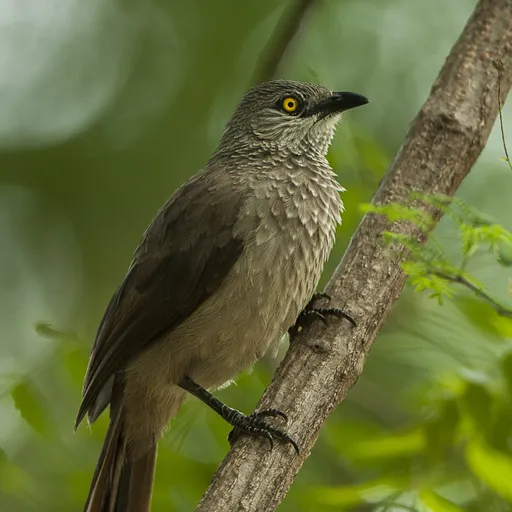
Brown Babbler
Turdoides plebejus
Least Concern
Overview
The brown babbler, also known as the Sudan babbler, is a medium-sized bird in the family Leiothrichidae that is predominantly found in West Africa. Classified as Least Concern by the IUCN, this common species ranges from The Gambia to Kenya and readily inhabits human-modified environments.
Identification
- Medium-sized bird measuring 22–25 cm in length with grey-brown plumage, bronze-brown wings, and a scaled head.
- Features a white-streaked throat and breast, a black bill, and dusky or slaty black legs with yellow irises.
- Juveniles appear similar to adults but have plainer, browner plumage and brown irises.
Habitat
Inhabiting the Sahel between the Sahara Desert and the tropical forests of West Africa, the range extends from southern Mauritania and Senegal to western Kenya. It thrives in open savanna, wooded grasslands, riparian habitats, degraded cultivation, and gardens. The species is mostly sedentary but may make seasonal movements related to the rainy season.
Diet
The brown babbler feeds on a variety of insects such as ants, beetles, termites, and praying mantises, alongside other invertebrates, berries, and fruit. It forages generally on the ground in family parties of up to 14 individuals and will opportunistically take carrion.
Did you know?
The species is closely related to and forms a superspecies with the white-headed babbler of eastern Sudan and the arrow-marked babbler of central and southern Africa.
Sources
- Wikipedia · CC BY-SA 4.0
- Wikidata · CC0 1.0