
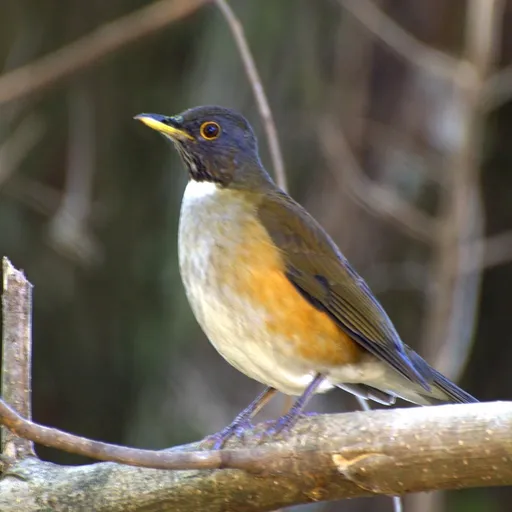
White-necked Thrush
Turdus albicollis
Least Concern
Listen
XC251684 · Niels Krabbe · Napo: Napo Galeras, Ecuador · CC BY-SA 4.0
Overview
The Turdus albicollis, or white-necked thrush, is a species in the family Turdidae with a disjunct distribution across South America and Trinidad and Tobago. Previously referred to as the white-necked robin, its taxonomy is complex, with seven subspecies currently recognised by some authorities, though others have split groups into separate species based on flank colouration.
Identification
- Length of 20.5 to 26 cm and weight of 40 to 84.5 g, with sexes having identical plumage.
- Nominate adults feature a blackish-brown head, a white throat streaked with blackish, and a yellow to orange eye-ring.
- Upperparts, wings, and tail are dark brown, while the underparts consist of a buff-gray breast, brown-washed orangey flanks, and a white lower belly.
- A melodious song characterised by paired, sing-song phrases described as 'hypnotic', accompanied by abrupt calls when foraging.
Habitat
Found in the interior, edges, and clearings of forest types, favouring terra firme and also inhabiting várzea and mature secondary forest. The species ranges up to 2,600 m in Colombia, 1,900 m in Venezuela, and 1,500 m in Brazil, though it rarely enters open areas except to use trails and roadsides.
Diet
Feeds on insects, invertebrates such as worms, fruit, berries, and seeds, foraging mostly on the ground but moving up to the forest's mid-story for fruit. It regularly attends army ant swarms but does not join mixed-species feeding flocks.
Did you know?
Despite being socially monogamous, extra-pair mating is common among white-necked thrushes. The species constructs bulky cup nests from mud, leaves, and twigs, which are sometimes placed on earthen banks or within epiphytes.
Sources
- Wikipedia · CC BY-SA 4.0
- Wikidata · CC0 1.0