
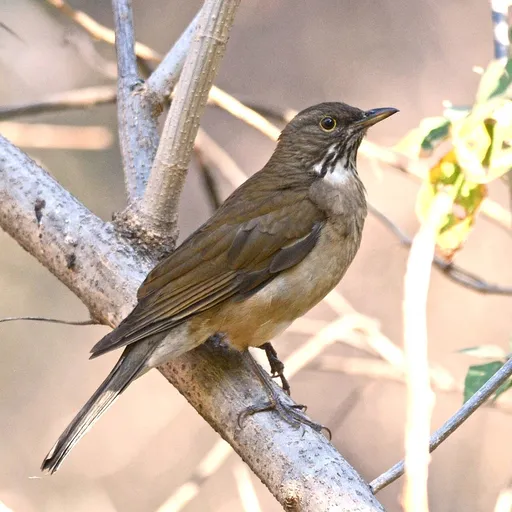
White-throated Thrush
Turdus assimilis
Least Concern
Overview
The white-throated thrush (Turdus assimilis) is a species of bird in the family Turdidae, widely distributed across Mexico and Central America. It was previously classified as the white-throated robin, a name that is now reserved for the Old World species Iranina gutturalis.
Identification
- Length of 22 to 26.5 cm with a weight of approximately 61 to 90 g.
- Plumage varies by subspecies; the nominate subspecies features rusty brown upperparts and a white throat marked with dark brown streaks.
- A white crescent is present below the throat, with the breast in pale olive-brown transitioning to white on the belly and vent.
- Adults possess a reddish-brown iris, a dark maxilla, a mixed yellow and dark mandible, and dirty yellow legs.
- Song varies by subspecies but is generally described as a long, varied series of well-spaced, sweet clear whistled phrases.
Habitat
The species is found across Mexico and Central America, occasionally straying into the southwestern United States. It primarily inhabits wooded environments, including coniferous, deciduous, and evergreen forests, as well as plantations and gallery forests. In non-breeding seasons, migratory populations may occupy more open landscapes such as savannas, hedgerows, and gardens, generally favouring areas with fruiting trees.
Diet
The white-throated thrush feeds on fruit, insects, and other invertebrates such as worms. Foraging typically occurs near or on the ground, but the bird will also ascend into fruiting trees. During the breeding season it forages in pairs, while in the non-breeding season it often forages in mixed-species flocks.
Did you know?
The bird is described as a 'talented vocalist' that sings surprisingly varied phrases ranging from tuneful whistles to thin trills, typically in couplets. Its subspecies T. a. coibensis is an outlier among its kind, with a song that is noticeably different from all other subspecies.
Sources
- Wikipedia · CC BY-SA 4.0
- Wikidata · CC0 1.0