
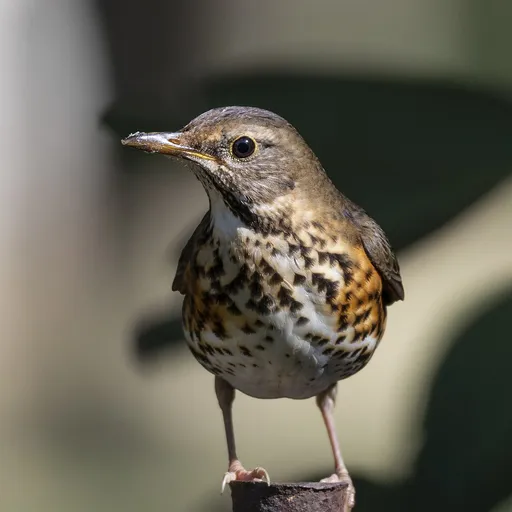
Japanese Thrush
Turdus cardis
Least Concern
Overview
The Japanese thrush (Turdus cardis), also known as the grey thrush, is a migratory bird species in the thrush family Turdidae. It breeds in central China and Japan before wintering in coastal southern China and northern Laos and Vietnam. The species is currently classified as Least Concern on the IUCN Red List.
Identification
- The male features a black head, breast, back, wings, and tail, contrasting with a white underside marked by black spots on the upper belly and flanks.
- The female is brown above with a white throat, breast, and belly, washed with rusty orange on the flanks and speckled with black spots.
- Both sexes possess yellow legs, bill, and a thin eye-ring, and are described as mid-sized thrushes.
Habitat
This species inhabits forests and woodlands, preferring deciduous or mixed deciduous and coniferous types in breeding areas, though it also utilizes secondary forest, gardens, and parks. It is found in central China and Japan during the breeding season and moves to coastal southern China, Hainan, and northern Laos and Vietnam for wintering. It occasionally appears as a passage migrant in Taiwan and has been recorded as a vagrant in Thailand.
Diet
The Japanese thrush forages on the ground by scratching through leaf-litter to locate insects and earthworms. It also consumes fruit as part of its diet.
Did you know?
The species is capable of double brooding, meaning the female lays a new clutch soon after the first brood has fledged, resulting in two broods raised per season.
Sources
- Wikipedia · CC BY-SA 4.0
- Wikidata · CC0 1.0