
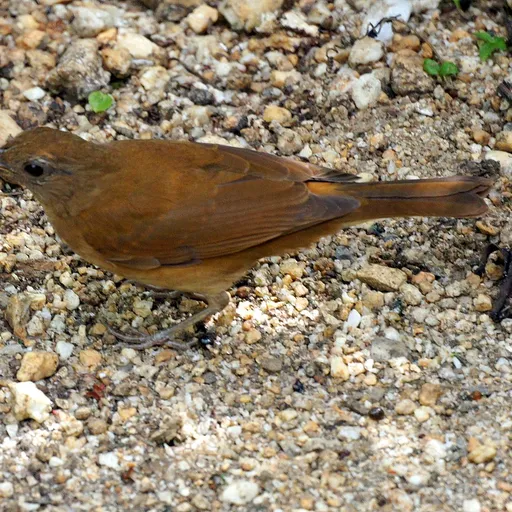
Cocoa Thrush
Turdus fumigatus
Least Concern
Overview
The cocoa thrush (Turdus fumigatus) is a species of bird in the family Turdidae found across parts of South America and the Caribbean. It is a year-round resident that inhabits a wide variety of landscapes, from humid forests and clearings to cultivated areas and plantations. The species is currently assessed as Least Concern by the IUCN, although its population is believed to be decreasing.
Identification
- Measures 21.5 to 24 cm in length and weighs 55 to 83 g, with identical plumage in both sexes.
- Adults of the nominate subspecies display a foxy-brown head, upperparts, wings, and tail, with a whitish buff throat streaked with dark marks.
- Breast and flanks are pale orange-brown, while the belly to vent is whitish with brown feather tips.
- Features a dark iris and brownish gray bill, legs, and feet; the nominate song is a long, musical caroling with slurred phrases.
Habitat
The cocoa thrush inhabits varied landscapes, often somewhat open, including the interior, clearings, and edges of humid forest, as well as gallery forest and open woodlands. It shows a preference for areas near water, such as swampy locales and várzea forest, and is regularly found in parks, gardens, and cacao or shade coffee plantations. Its range extends from the southern and eastern edges of Amazonian Brazil to the Lesser Antilles, reaching elevations up to 1,800 m in Venezuela.
Diet
The cocoa thrush feeds on fruit, larval and adult insects, and other invertebrates such as worms and millipedes. It takes fruit from trees but acquires the majority of its diet items primarily on the ground.
Did you know?
On Trinidad, the cocoa thrush breeds year-round except for September, with pairs capable of raising up to four broods in a single season. Its nest is a bulky cup constructed from plant material and mud, featuring moss on the outside and a lining of rootlets.
Sources
- Wikipedia · CC BY-SA 4.0
- Wikidata · CC0 1.0