
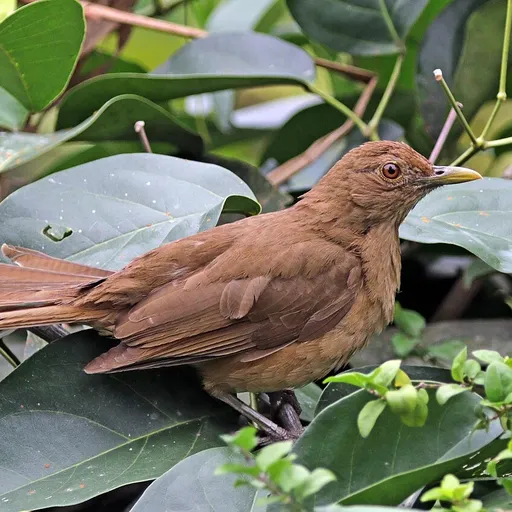
Clay-colored Thrush
Turdus grayi
Least Concern
Overview
The clay-colored thrush (Turdus grayi), also known as the clay-colored robin, is a common Middle American bird of the thrush family (Turdidae). It is the national bird of Costa Rica, where it is widely recognised as the yigüirro.
Identification
- Size is comparable to or slightly smaller than the American robin, measuring 23–27 cm in length and weighing 74–76 g on average.
- Plumage is generally brownish, lighter below than above with the flanks being the lightest; birds from humid regions are darker than those from dry regions.
- The bill is greenish-yellow with a dark base, legs are pinkish or flesh-coloured, and irises are reddish.
- Song is low-pitched with a slow, steady tempo, consisting of slurred musical phrases often repeated irregularly.
Habitat
The species ranges from South Texas, where it is rapidly expanding, to northern Colombia. West and north of the Isthmus of Tehuantepec, it is limited to the Atlantic slope, except for a population around Oaxaca City that likely originates from escaped cage birds. In much of its range, it is familiar in yards and gardens.
Diet
The clay-colored thrush usually forages for fruit or invertebrates on the ground or near it, singly or in pairs, though flocks may feed high in fruiting trees. It will also follow army ants to feed on small prey disturbed by the ant columns.
Did you know?
It is one of only very few bird species that are partial ejectors of brood parasite eggs, with only about 25% of individuals ejecting the eggs of the bronzed cowbird. Costa Ricans chose it as their national symbol in 1977, despite it being less colourful than many other species, because its strong and melodious song traditionally signals the start of the rainy season.
Sources
- Wikipedia · CC BY-SA 4.0
- Wikidata · CC0 1.0