
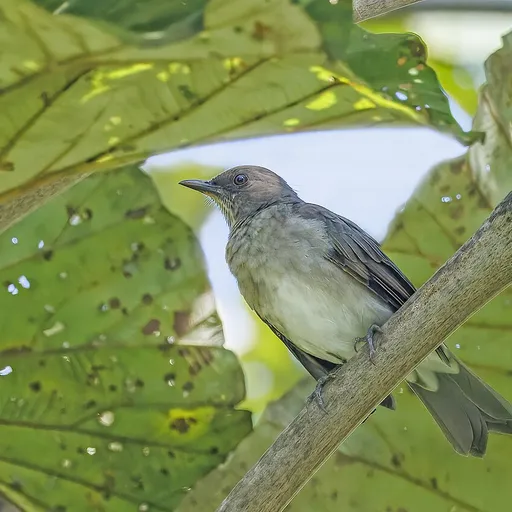
Black-billed Thrush
Turdus ignobilis
Least Concern
Overview
The black-billed thrush (Turdus ignobilis) is a species of bird in the family Turdidae with a disjunct distribution across South America. It is considered a sedentary year-round resident and is found in a variety of semi-open to open landscapes from the Andes to the Amazon.
Identification
- 18.5 to 24 cm long and weighing 48 to 81 g, with sexes displaying the same plumage.
- The nominate subspecies has an olive-brown head and upperparts, an off-white throat with dark streaks, and a black bill and iris.
- Subspecies vary in plumage, with T. i. goodfellowi having warmer, darker upperparts and T. i. debilis showing more white on the throat and weaker streaks.
- Vocalisation includes a slow, caroling song with repetitive phrases and calls such as a loud pfeea! or wEEa! in Venezuela.
Habitat
The species inhabits semi-open to open landscapes, including forest edges, gallery forests in savanna, secondary forest, shade coffee plantations, and human-maintained areas like parks and gardens. Its range is disjunct, with subspecies found in the Andes of Colombia and Venezuela, and a separate, wider range through Ecuador, Peru, Bolivia, and Brazil, often along major river corridors.
Diet
The black-billed thrush feeds on berries, seeds, insects, and other invertebrates such as worms. It usually forages singly or in pairs and rarely joins mixed-species flocks, taking fruit from trees and shrubs but also feeding on the ground in sheltered areas.
Did you know?
The bird's breeding season has not been fully defined, but it spans from November to February in Ecuador and includes January in Peru. Its nest is a cup made from moss and mud lined with finer fibres, and the clutch consists of two or three greenish-blue eggs heavily marked with brown.
Sources
- Wikipedia · CC BY-SA 4.0
- Wikidata · CC0 1.0