
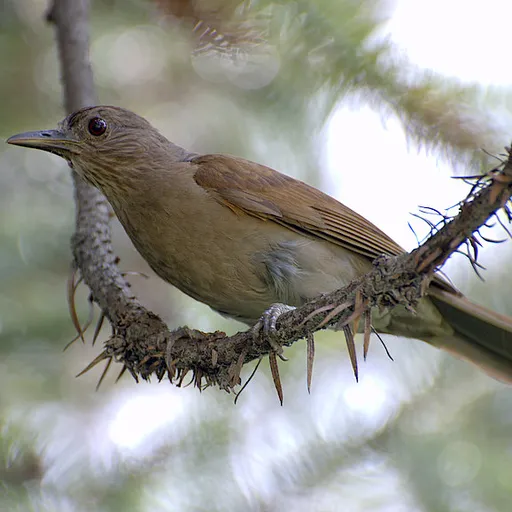
Pale-breasted Thrush
Turdus leucomelas
Least Concern
Overview
The pale-breasted thrush (Turdus leucomelas) is a species of bird in the family Turdidae found across most of mainland South America, excluding Chile and Ecuador. It is currently classified as Least Concern on the IUCN Red List, with a stable population and a very large range.
Identification
- Length of 23 to 27 cm with a weight of 47 to 78 g.
- Upperparts are generally pale olive brown, while the breast and flanks are pale grayish buff and the throat is whitish with thin brown streaks.
- Possesses a dark iris, a greenish-yellow bill, and light brown legs.
- Song consists of melodious phrases such as "chirr juep juele chip chirr", compared to the American robin but more complex, accompanied by a distinctively guttural, rattly wooden call.
Habitat
The species inhabits a wide variety of somewhat open landscapes, including forest edges, secondary forest, savanna, palm groves, plantations, and gardens that offer shrubs for shade. It is found in every mainland South American country except Chile and Ecuador, ranging in elevation up to 2,000 m in Venezuela and typically up to 1,500 m in Brazil.
Diet
The pale-breasted thrush feeds mostly on fruits, both wild and cultivated, taking them from trees or gathering fallen fruit on the ground. It supplements this diet with small amounts of insects, worms, and small lizards.
Did you know?
The thrush frequently benefits from human activity, utilizing man-made structures such as window ledges, rafters, and air conditioners for nesting. Its nest is a bulky cup constructed from moss and rootlets held together with mud.
Sources
- Wikipedia · CC BY-SA 4.0
- Wikidata · CC0 1.0