
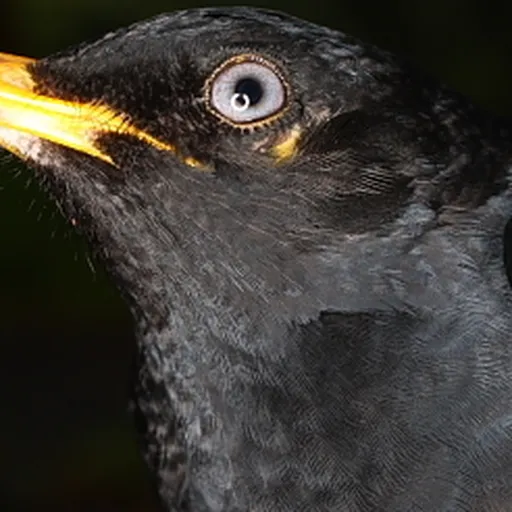
Pale-eyed Thrush
Turdus leucops
Least Concern
Listen
XC251708 · Niels Krabbe · Napo: Napo Galeras, Ecuador · CC BY-SA 4.0
Overview
The pale-eyed thrush (Turdus leucops) is a species of bird in the family Turdidae, classified by the IUCN as Least Concern. It is a monotypic species with a highly disjunct distribution across northern South America.
Identification
- Adult males are almost entirely glossy bluish black, featuring a bluish white iris, a bright yellow to orange bill, and matching legs.
- Adult females possess olive-brown upperparts, light brown to buff throats with brown streaks, and light brown to brown irises.
- The species measures 19.5 to 23.5 cm in length and weighs between 54 and 80 g.
- Its song consists of a disjointed, choppy series of short phrases, such as 'wheero-weet' and 'chup-e', often delivered from high in the canopy.
Habitat
Found in Bolivia, Brazil, Colombia, Ecuador, Guyana, Peru, Suriname, and Venezuela, the species inhabits humid to very wet pristine forest, especially cloudforest, as well as wet semi-deciduous and riparian forest. It shuns built-up areas and typically ranges between 850 and 2,600 m in elevation, with variations depending on the country.
Diet
This thrush feeds primarily on seeds and berries, while also consuming invertebrates and small vertebrates. It forages singly or in pairs during the breeding season and in flocks outside of it, primarily in the mid-level to lower parts of the canopy. The bird follows army ant swarms to capture small prey and takes fruit while perched or briefly hovering.
Did you know?
The pale-eyed thrush constructs its cup nests from moss and plant fibres, sometimes incorporating soil at the bottom, and places them in trees between 0.7 and 4 m above the ground or on earthen banks. While the female solely incubates the two-egg clutch for 13 to 15 days, both parents participate in provisioning the nestlings once they hatch.
Sources
- Wikipedia · CC BY-SA 4.0
- Wikidata · CC0 1.0