
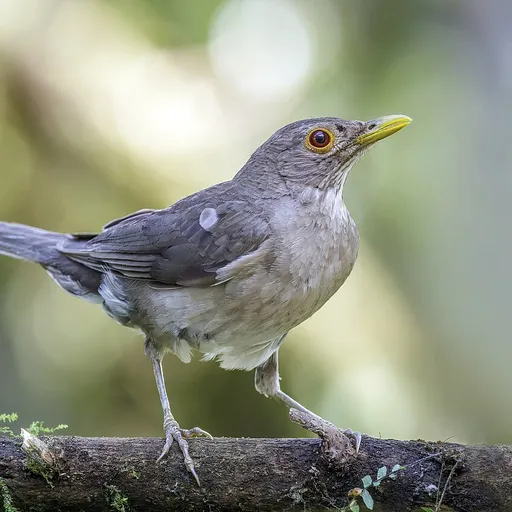
Ecuadorian Thrush
Turdus maculirostris
Least Concern
Listen
XC243247 · Niels Krabbe · El Oro: Daucay, Ecuador · CC BY-SA 4.0
Overview
The Ecuadorian thrush (Turdus maculirostris) is a species of bird in the family Turdidae found in Ecuador and Peru. It is considered the most numerous and widespread Turdus in western Ecuador and is fairly common in its small Peruvian range.
Identification
- Adults are 21.5 to 23 cm long with olive-brown upperparts, wings, and tail, and a paler olive-brown breast and flanks.
- Features include a white throat with dark streaks, whitish belly and vent, dark iris, dusky yellow bill, and olive-brownish legs and feet.
- Juveniles have thin buff streaks on the upperparts, orangey wing bars, and dark brown mottling on the breast and flanks.
- The song is described as a musical caroling, and the principle call is a distinctive cat-like and querulous queeoww, alongside a chuk call.
Habitat
Found in western Ecuador from just south of the Colombian border south through the length of the country and into far northwestern Peru’s Tumbes Department. It inhabits a variety of somewhat open lowland and subtropical landscapes, including light forest and woodlands, clearings and edges of denser forest, and gardens near forest. In Ecuador it mostly ranges from sea level to 1,900 m, and in Peru between 400 and 750 m.
Diet
Little is known about the Ecuadorian thrush’s diet or foraging behavior. It is known to forage mostly in trees.
Did you know?
The nest is built from plant fibers, mud, and moss, and is placed on a stump, in a branch fork, or on a branch between about 0.5 and 6 m above the ground. The only known clutch consists of three eggs that are deep turquoise to dull greenish blue and spotted with red-brown.
Sources
- Wikipedia · CC BY-SA 4.0
- Wikidata · CC0 1.0