
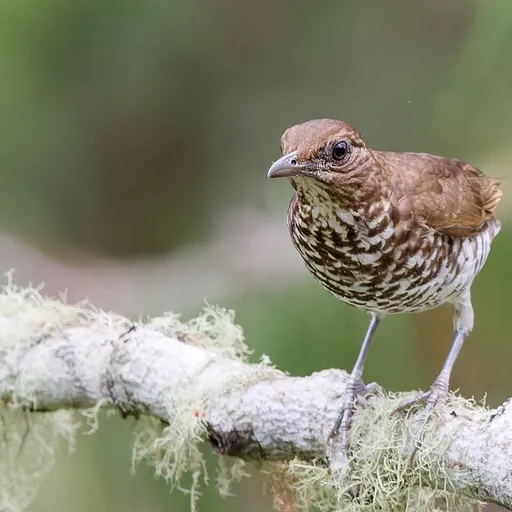
Maranon Thrush
Turdus maranonicus
Least Concern
Listen
XC243252 · Niels Krabbe · Zamora-Chinchipe: SE Zumba: turnoff to Chito on La Chonta - El Chorro road, Ecuador · CC BY-SA 4.0
Overview
The Marañón thrush (Turdus maranonicus) is a species of bird in the family Turdidae, found in the upper and middle basins of the Marañón River in extreme southern Ecuador and northern Peru. It is assessed by the IUCN as a species of Least Concern.
Identification
- Adults are 21.5 to 23 cm long with a mostly rich brown head and upperparts, paired with a brown-streaked whitish throat.
- Underparts are dull white, featuring a brown scaly and spotted pattern on the breast and flanks.
- Possesses a dark iris, a grayish bill, and grayish legs and feet.
- Song is described as a slow caroling similar to that of the Black-billed Thrush, though it does not repeat phrases.
Habitat
The bird inhabits rather dry landscapes including dry forest, secondary forest, riparian forest, scrublands, and gardens, as well as the edges of more humid forest and woodland. Its elevation ranges between 650 and 1,600 m in Ecuador and 400 and 2,000 m in Peru.
Diet
While the specific diet of the Marañón thrush is not known, it forages mostly on the ground, often in very open areas such as plowed fields and grassy areas.
Did you know?
Although its specific diet remains a mystery, its vocalisations include distinct calls such as a rising 'rzeet rzeet', a ringing 'tseet', and a 'mello wurk'.
Sources
- Wikipedia · CC BY-SA 4.0
- Wikidata · CC0 1.0