
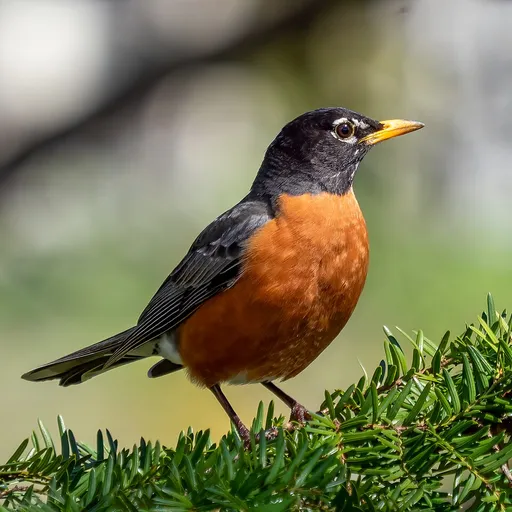
American Robin
Turdus migratorius
Least Concern
Listen
XC570791 · Doug Hynes · Goulds, Newfoundland and Labrador, Canada · CC BY-SA 4.0
Overview
The American robin (Turdus migratorius) is a migratory bird in the thrush family, widely distributed throughout North America. It is the most abundant landbird on the continent, with an estimated 370 million individuals.
Identification
- Length of 23 to 28 cm with a wingspan of 31 to 41 cm, averaging 77 g in weight.
- Adult plumage features a brown back, a reddish-orange breast varying from maroon to peachy orange, and a head that ranges from jet black to gray.
- Distinguishing markings include white eye arcs, white supercilia, a white throat with black streaks, and a white belly.
- The bill is mainly yellow with a dark tip, while the legs and feet are brown; females are generally duller with a brown tint to the head.
- The song is a complex, cheery carol consisting of repeated discrete units with brief pauses.
Habitat
Breeding habitat includes woodland, open farmland, and urban areas, with the species becoming less common in the southernmost Deep South where it prefers large shade trees on lawns. It winters from southern Canada to central Mexico and along the Pacific Coast, occupying similar habitats but including more open areas.
Diet
The diet consists of approximately 40 percent invertebrates such as earthworms, beetle grubs, and caterpillars, and 60 percent wild and cultivated fruits and berries. Robins forage primarily on the ground, using visual and auditory cues to locate prey, often running and stopping to pounce on worms. They have evolved to lose sucrase, making sucrose unpalatable, which humans can use as a deterrent.
Did you know?
American robins will flock to fermented Pyracantha berries and, after eating sufficient quantities, exhibit intoxicated behavior such as falling over while walking.
Sources
- Wikipedia · CC BY-SA 4.0
- Wikidata · CC0 1.0