
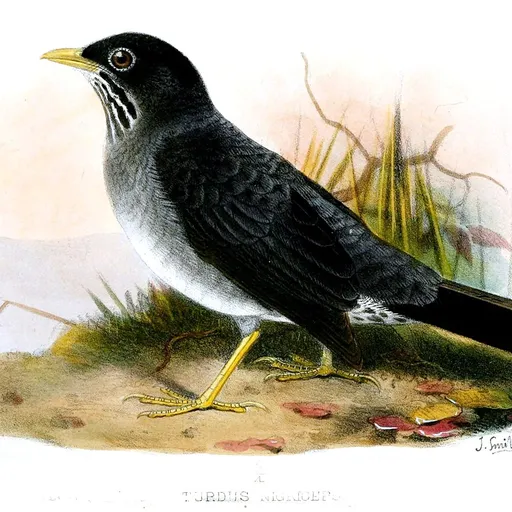
Andean Slaty Thrush
Turdus nigriceps
Least Concern
Listen
XC251719 · Niels Krabbe · Azuay: upper Yunguilla Valley, Ecuador · CC BY-SA 4.0
Overview
The Andean slaty thrush (Turdus nigriceps) is a sexually dimorphic species of thrush found across several South American countries. It inhabits various subtropical landscapes on both the western and eastern slopes of the Andes.
Identification
- Males possess a slate-gray head with a pale eye-ring and dark-streaked white throat, while females display greenish brown upper and underparts.
- Both sexes feature dark irises, a yellow bill, and yellow legs and feet.
- Length ranges from 18 to 23.5 cm (7.1 to 9.3 in) with a weight between 50 and 67.5 g (1.8 to 2.4 oz).
- Juveniles resemble adult females but exhibit orange-buff spots and streaks on the upperparts and buff to orangey underparts with a darker scaly pattern.
Habitat
Found on the western slopes of the Andes from southern Ecuador to northwestern Peru, and on the eastern slopes from southeastern Ecuador through Peru and Bolivia to central Argentina. The species occupies humid montane forests, secondary woodlands, and Eucalyptus plantations that maintain native undergrowth, favouring areas with dense vegetation along streams.
Elevation ranges vary by region, spanning from 300 m to 3,450 m across its distribution.
Diet
The bird feeds predominantly on fruit but also consumes insects and other invertebrates. Foraging occurs mostly in the lower and mid-levels of the forest, though it regularly feeds on the ground and in meadows near the forest edge.
Did you know?
The Andean slaty thrush is a partial or complete migrant that breeds on the western slope of the Andes but vacates this area during the non-breeding season. It is currently assessed as Least Concern on the IUCN Red List, despite a believed decreasing population size.
Sources
- Wikipedia · CC BY-SA 4.0
- Wikidata · CC0 1.0