
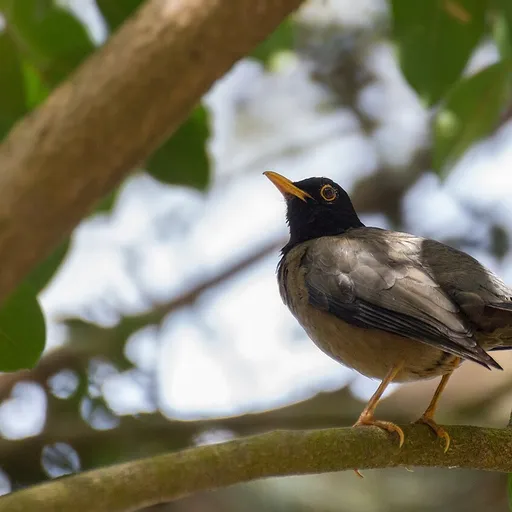
Black-hooded Thrush
Turdus olivater
Least Concern
Overview
The black-hooded thrush (Turdus olivater) is a species of bird in the family Turdidae found in South America. It is classified as Least Concern on the IUCN Red List, though its population is believed to be decreasing.
Identification
- Adult males of the nominate subspecies have an almost entirely black head and upper breast with a thin yellow eye-ring, while females have a mostly brown head with buff flecking on the face and throat.
- Both sexes feature dark olive-brown upperparts, wings, and tails, with underparts ranging from sandy-orange in males to paler with darker specks on the vent in females.
- The bird measures 23 to 24 cm in length and weighs between 70 and 91 g, possessing a yellow bill, legs, and feet.
- The song is described as a full-bodied, warbling carol with phrases of two or three syllables, often interspersed with high thin notes.
Habitat
This species inhabits humid montane forest, secondary forest, and shade coffee plantations across a highly disjunct range in Brazil, Colombia, Guyana, Suriname, and Venezuela. Elevation varies by region, typically ranging from 600 m in Colombia to 2,600 m in Brazil and Venezuela.
Diet
Although not extensively studied, the diet is known to include fruit, which the bird obtains by foraging on the ground by flipping over leaf litter or in fruiting trees. It also occasionally attends army ant swarms.
Did you know?
The bird builds a cup nest of mosses and mud typically near the ground, laying a clutch of two to three eggs that are pale blue with purple and light brown spots.
Sources
- Wikipedia · CC BY-SA 4.0
- Wikidata · CC0 1.0