
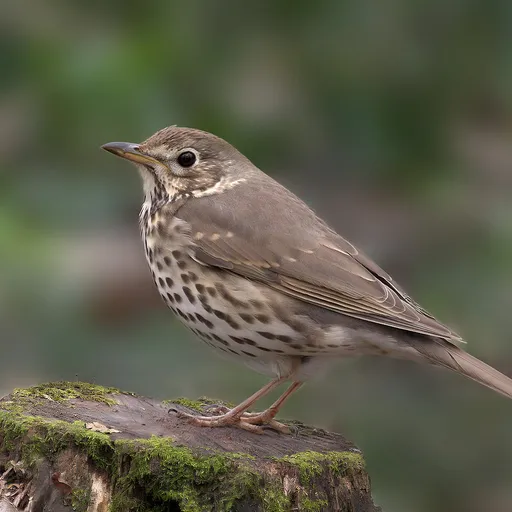
Song Thrush
Turdus philomelos
Least Concern
Listen
XC1079694 · Lionel Triboulin · Arrondissement de Rouen (near Le Mesnil-Esnard), Seine-Maritime, Normandie, France · CC0 1.0
Overview
The song thrush (Turdus philomelos) is a thrush species that breeds across the West Palearctic. It is classified as Least Concern on the IUCN Red List, despite experiencing serious population declines in parts of Europe due to agricultural changes.
Identification
- Brown upperparts with black-spotted cream or yellow-buff underparts that become paler on the belly.
- Length of 20 to 23.5 cm with a yellowish bill and pink legs and feet.
- Loud, clear song consisting of musical phrases repeated two to four times, often interspersed with mimicry.
- Short, sharp 'tsip' call, distinct from the thin high 'seep' used during migration.
Habitat
Breeds in forests, gardens, parks, and hedgerows across most of Europe, extending into Ukraine and Russia. Partially migratory, with many individuals wintering in southern Europe, North Africa, and the Middle East, while some populations in milder western regions are resident. The species has also been introduced to New Zealand and Australia.
Diet
Omnivorous, feeding on invertebrates such as earthworms and snails, as well as soft fruit and berries. Uses a run-and-stop hunting technique on open ground and rummages through leaf-litter. Notably uses a favourite stone as an anvil to break open snail shells.
Did you know?
The song thrush is the emblem of West Bromwich Albion Football Club because the public house where the team used to change kept a pet thrush in a cage, giving the team their early nickname, 'The Throstles'.
Sources
- Wikipedia · CC BY-SA 4.0
- Wikidata · CC0 1.0