
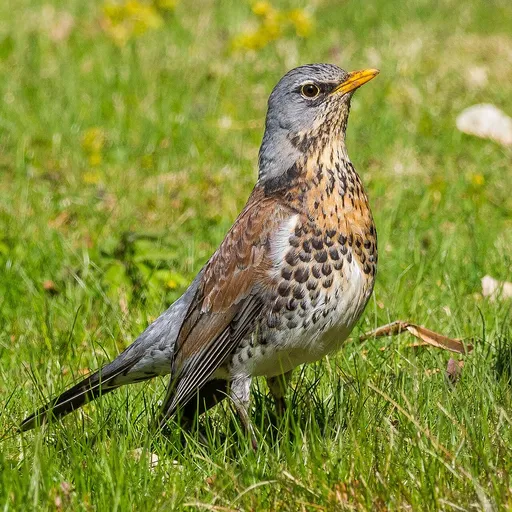
Fieldfare
Turdus pilaris
Least Concern
Listen
XC834617 · Grégoire Chauvot · Tromsø, Tromsø, Troms og Finnmark, Norway · CC0 1.0
Overview
The fieldfare (Turdus pilaris) is a thrush that breeds in the woodlands and scrub of northern Europe and across the Palearctic. It is strongly migratory, with northern populations moving south for the winter, and is considered to be of least concern regarding conservation status.
Identification
- A medium-sized bird approximately 25 cm long featuring a slate-grey head, nape and rump contrasted with a dark brown back.
- The breast and flanks are heavily spotted with brownish-black marks on a creamy-buff background, with white underparts and conspicuous white under-wings in flight.
- The beak is strong and slightly curved, appearing orange-yellow in winter and yellow in the summer for males, with brown legs and feet.
- The harsh flight call is described as a 'tsak tsak tsuk', while the male sings a feeble song comprising chattering phrases, whistles and guttural squeaks.
Habitat
In summer, the species frequents mixed woodland of birch, alder, pine, spruce and fir, often near open ground or marshes, and also inhabits open tundra above the tree line. During the winter, it favours open country, agricultural land, orchards and open woodland, often foraging in flocks alongside redwings. Its breeding range extends across northern Europe and across the Palearctic to North West China, while wintering grounds include the United Kingdom, Southern Europe, North Africa and the Middle East.
Diet
As an omnivore, the fieldfare consumes snails, slugs, earthworms, spiders and various insects in the summer, switching to large quantities of berries such as hawthorn, holly and rowan in the autumn. In late winter it eats windfall apples, grain, seeds and swedes, and in particularly harsh weather may move to marshes or foreshores to feed on molluscs. Foraging on the ground is conducted in groups that work upwind, occasionally standing erect to gaze around before resuming feeding.
Did you know?
The English common name 'fieldfare' dates back to at least the 11th century, potentially deriving from the Old English 'feldefare' meaning 'traveller through the fields', or from 'fealu fearh' meaning 'grey piglet', which corresponds to an old Welsh name for the species.
Sources
- Wikipedia · CC BY-SA 4.0
- Wikidata · CC0 1.0