
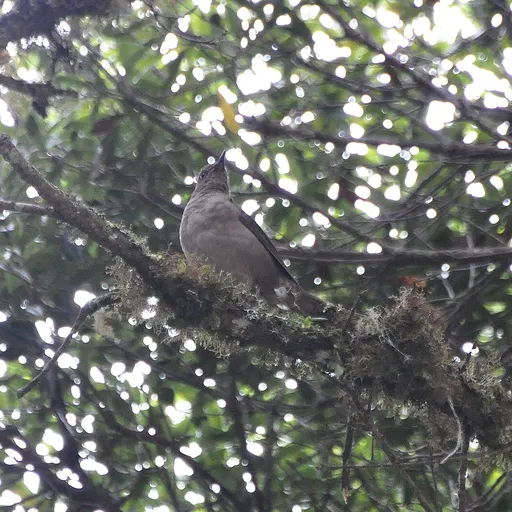
Mountain Thrush
Turdus plebejus
Least Concern
Overview
The Turdus plebejus, commonly known as the mountain thrush, is a species of bird in the family Turdidae found from Mexico to Panama. Formerly known as the mountain robin, it is also referred to as the American mountain thrush and is currently assessed as Least Concern by the IUCN.
Identification
- Measures 23 to 25.5 cm in length, with males averaging 81 g and females 92 g; sexes share the same plumage.
- Nominate subspecies exhibit mostly olivaceous brown upperparts with a browner head, a pale brown throat with faint sepia streaks, and light brown underparts that are palest on the belly.
- Features a dark brown iris, a blackish brown bill (brownish in some subspecies), and brown to dark brown legs and feet.
- Song consists of a warbling series of repeated elements described as "churee-churee-tea'rrr-clearer-clearer-cheer'up-cheer'up-here!", accompanied by a high-pitched, sharp "pseeeeep!" call.
Habitat
Inhabits the interior and edges of montane evergreen and pine-oak forests, favouring areas heavy with mosses and epiphytes, as well as pastures, gardens, and fruit-bearing groves. Its distribution is disjunct across southern Mexico, Guatemala, Honduras, Nicaragua, El Salvador, Costa Rica, and western Panama, generally ranging in elevation between 900 and 3,500 m.
Diet
Diet comprises insects, other invertebrates, seeds, and berries, though it has not been formally studied. Forages singly or in pairs during the breeding season and in small flocks at other times, usually operating from mid-levels to the canopy of the forest.
Did you know?
The species constructs a bulky cup nest from moss lined with dry bamboo leaves, rootlets, and other plant material, typically placed in dense epiphytes 3 to 12 m above the ground. Its clutch consists of two or three plain blue-green eggs.
Sources
- Wikipedia · CC BY-SA 4.0
- Wikidata · CC0 1.0