
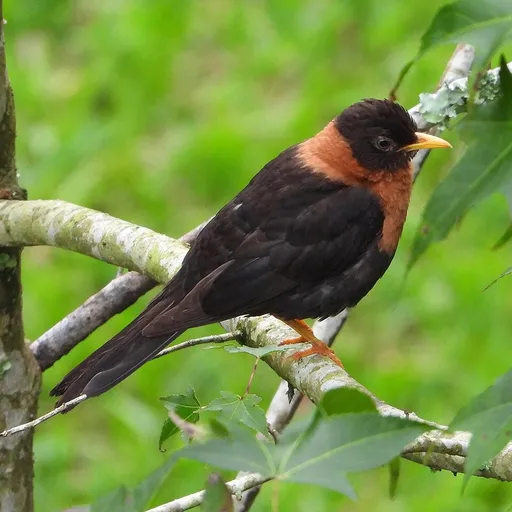
Rufous-collared Thrush
Turdus rufitorques
Least Concern
Overview
The rufous-collared thrush (Turdus rufitorques) is a species of bird in the family Turdidae found in El Salvador, Guatemala, Honduras, and Mexico. Some taxonomic systems refer to it as the rufous-collared robin. The species is monotypic and its closest relative is the American robin (Turdus migratorius), with recent genetic studies suggesting it may be embedded within American robin populations.
Identification
- Males feature a mostly black head with a whitish chin and throat streaked with black and cinnamon-rufous, alongside a wide cinnamon-rufous or chestnut-rufous collar extending to the breast, and black flanks, belly, and undertail coverts.
- Females resemble males but possess lighter, duller colors, a brownish crown with darker streaks, a grayish-brown head, and buffy cinnamon or tawny collars and breasts with buffy grayish, white-streaked underparts.
- Adults measure 23 to 25.5 cm in length and weigh between 70 and 74 g, with dark brown irises; adult males have bright yellow-orange bills, legs, and feet, while females have light orange-brown bills, legs, and feet.
- The song consists of evenly spaced high-pitched warbling whistles and trills, and the call is described as 'chut'chut'chut'.
Habitat
The species inhabits primary montane evergreen forest, pine-oak forest, and secondary forest in subtropical and lower temperate zones, as well as grassy clearings, villages, and urban areas between 1,500 and 3,300 m elevation. Its distribution is disjunct, spanning parts of southern Mexico, southern Guatemala, south-central Honduras, and western El Salvador.
Diet
The diet is assumed to be similar to that of the American robin, consisting mainly of insects and some small fruits, though it has not been specifically studied. The thrush generally forages alone or with its mate, but outside the breeding season may gather in small flocks, feeding at all levels of the forest from the ground to the canopy.
Did you know?
Recent genetic studies suggest the rufous-collared thrush may be genetically embedded within American robin populations, highlighting its close evolutionary relationship with this North American species.
Sources
- Wikipedia · CC BY-SA 4.0
- Wikidata · CC0 1.0