
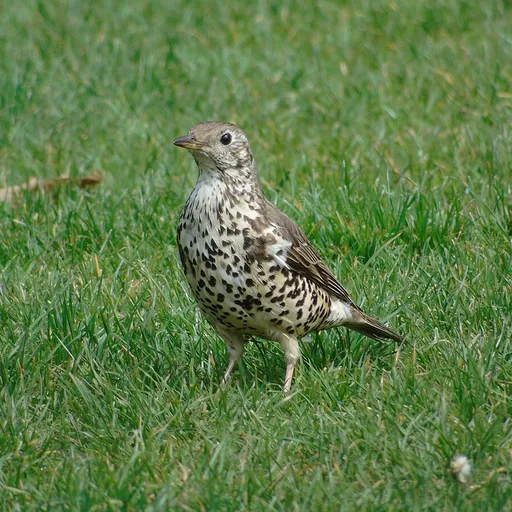
Mistle Thrush
Turdus viscivorus
Least Concern
Listen
XC815475 · Sonothèque ADVL · Carolles, Manche, Normandie, France · CC0 1.0
Overview
The mistle thrush is the largest thrush native to Europe, found in open woods, parks, and cultivated land across much of Europe, temperate Asia, and North Africa. It is a year-round resident in many parts of its range, though northern and eastern populations migrate south for the winter. Classified as Least Concern, the species has expanded its range into suburban areas in central Europe despite recent declines in some agricultural regions.
Identification
- Pale grey-brown upperparts with a greyish-white chin and throat.
- Yellowish-buff breast and off-white belly marked with round black spots that become denser on the lower chest.
- Blackish bill with a yellowish base to the lower mandible and yellowish-brown legs.
- Loud, far-carrying song with fluted whistles, often audible up to 2 km away even in wet and windy weather.
Habitat
The species inhabits a wide range of environments containing trees, including forests, plantations, hedges, and town parks. In southern and eastern regions, it prefers upland coniferous woodland and can be found in milder uplands and coastal areas. More open habitats, such as agricultural land, moors, and grassy hills, are extensively used in winter or during migration.
Diet
The mistle thrush feeds on a wide variety of invertebrates, seeds, and berries, with a strong preference for mistletoe, holly, rowan, and yew fruits. It forages on the ground and from low bushes, and in winter will vigorously defend fruit-bearing trees against other birds. Snails are sometimes smashed on a stone 'anvil', a technique also used by the song thrush.
Did you know?
The thrush is ecologically vital for the propagation of mistletoe, a parasitic plant, as it digests the nutritious fruit and excretes the sticky seeds onto tree branches where they can germinate. This relationship is so central to the bird's identity that its scientific name, Turdus viscivorus, literally translates to 'mistletoe eater'.
Sources
- Wikipedia · CC BY-SA 4.0
- Wikidata · CC0 1.0