
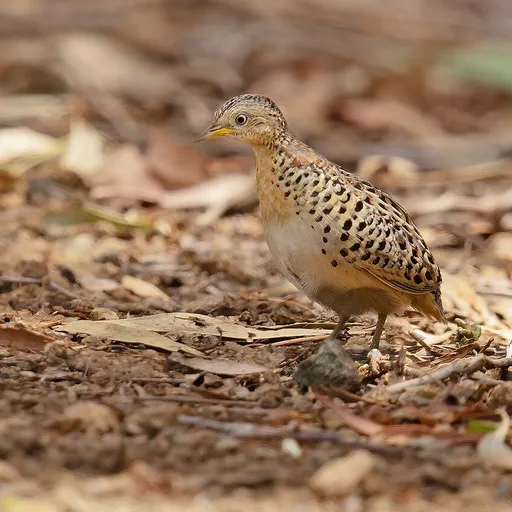
Red-backed Buttonquail
Turnix maculosus
Least Concern
Overview
The red-backed buttonquail (Turnix maculosus) is a small stocky bird in the family Turnicidae, native to Southeast Asia and Oceania. It is a ground-dwelling species that is currently assessed as Least Concern by the IUCN, although its total numbers are thought to be decreasing due to habitat degradation.
Identification
- Small stocky bird, 12–16 cm in length, with round-tipped wings and a short tail.
- Upper parts are slate grey, narrowly barred with reddish-brown and black; underparts are buff with bold spots and scallops on the sides.
- Head features include a blackish scalloped top, brownish-buff sides and throat, and a reddish-brown partial collar.
- Females are larger and more vividly coloured than males, with a brighter yellow beak and more distinctive chestnut collar; juveniles are much darker.
Habitat
Found in a coastal strip of Australia from northeastern Western Australia to Cape York and southward to northeastern New South Wales, as well as in Indonesia, Papua New Guinea, the Philippines, the Solomon Islands, and East Timor. It mostly inhabits rough, tussocky grassland, woods, and cropped land, usually near water in areas with at least 400 mm of summer rain, though some subspecies reach altitudes over 2,000 m.
Diet
It feeds on the seeds of grasses and sedges, other seeds, green plant matter, and insects. It likely consumes more insect prey than other members of its genus and forages on the ground, moving around alone, in pairs, or in small groups of up to five birds.
Did you know?
The female is serially polyandrous, meaning she seeks out another male to repeat the breeding process after laying her eggs, while the male takes over the exclusive care of the incubation and the young.
Sources
- Wikipedia · CC BY-SA 4.0
- Wikidata · CC0 1.0