
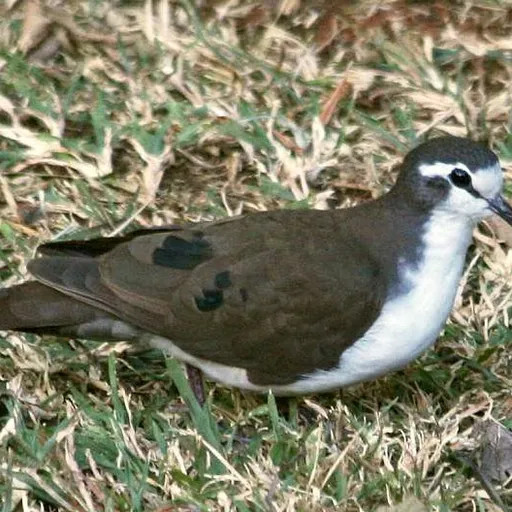
Tambourine Dove
Turtur tympanistria
Least Concern
Overview
The tambourine dove (Turtur tympanistria) is a small pigeon found as a widespread resident breeding bird in woodlands and thick vegetation across Africa south of the Sahara. It is a shy species that is typically seen when flushed from the forest floor, though it may occasionally associate with lemon doves or family groups.
Identification
- Small, plump pigeon measuring approximately 22 cm in length.
- Male features a white face with a black spot behind the eye, white underparts, and a grey crown, whereas females are duller with pale grey-brown faces and breasts.
- Both sexes possess purple-red eye rings and feet, along with a purple bill; folded wings display large dark purple patches in males.
- Distinctive call described as a persistently repeated 'du-du-du-du-du'.
Habitat
This species inhabits thick woodlands, including dense gardens and plantations of castor oil, cocoa, and rubber, extending from Senegal to Ethiopia and Kenya, and southwards to south-eastern South Africa. It is absent from the drier regions of south-western Africa but has a population on the Comoros Islands.
Diet
Being quite terrestrial, the tambourine dove usually forages on the ground for seeds and small fruits, with a specific preference for the seeds of the castor oil plant. It will also occasionally consume small insects and molluscs.
Did you know?
The bird builds a frail stick nest low in thickets or vine tangles, laying two cream-coloured eggs that hatch in 13 days. Although both sexes incubate, the task is performed mainly by the female, and the chicks are fed regurgitated food.
Sources
- Wikipedia · CC BY-SA 4.0
- Wikidata · CC0 1.0