
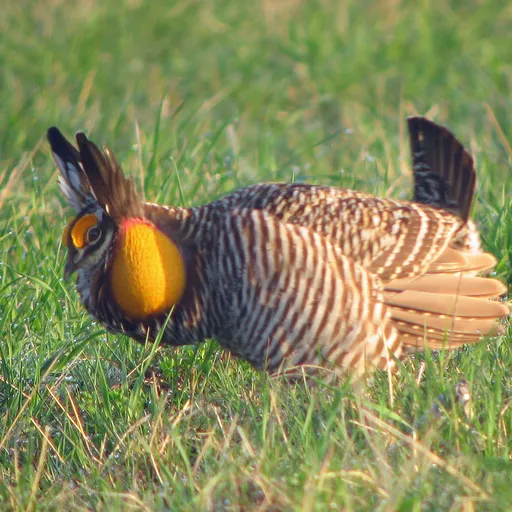
Greater Prairie Chicken
Tympanuchus cupido
Near Threatened
Overview
The greater prairie-chicken, or pinnated grouse (Tympanuchus cupido), is a large North American bird in the grouse tribe. Once abundant, it is now classified as Near Threatened and has become extremely rare or extirpated over much of its range due to habitat loss, natural disasters, and overhunting.
Identification
- Adults are medium to large, stocky, chicken-like birds approximately 43 cm long with short, rounded tails and round wings.
- Adult males feature orange comb-like feathers over their eyes, dark elongated head feathers, and an inflatable circular orange neck patch.
- Adult females possess shorter head feathers and lack the orange neck patch and yellow comb found in males.
- Mating displays involve inflating air sacs on the sides of the neck and snapping tails.
Habitat
This species prefers undisturbed tallgrass prairies and oak savannas, though it can tolerate agricultural land mixed with prairie. It is found across North America, although it is extirpated in Canada and restricted to small parcels of managed prairie in the United States.
Diet
The diet consists primarily of seeds and fruit, but during the summer the birds also consume green plants and insects such as grasshoppers, crickets, and beetles.
Did you know?
The specific epithet cupido was chosen because the bird's erectile neck feathers were thought to resemble the wings of Cupid.
Sources
- Wikipedia · CC BY-SA 4.0
- Wikidata · CC0 1.0