
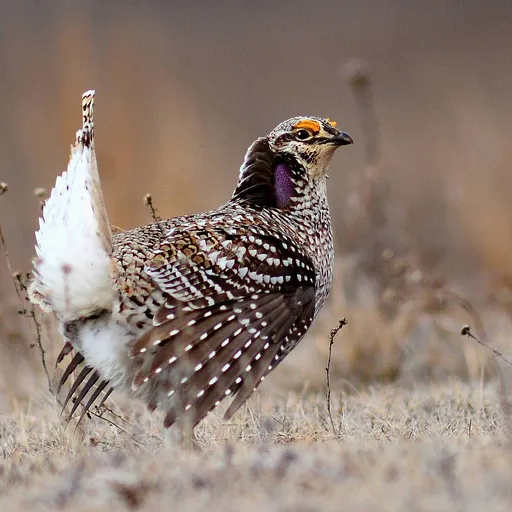
Sharp-tailed Grouse
Tympanuchus phasianellus
Least Concern
Overview
The sharp-tailed grouse (Tympanuchus phasianellus), also known as the sharptail or fire grouse, is a medium-sized prairie grouse found throughout Alaska, much of Northern and Western Canada, and parts of the Western and Midwestern United States. It is one of three species in the genus Tympanuchus and serves as the provincial bird of Saskatchewan.
Identification
- Adults feature mottled dark and light brown plumage on a white background, with a white belly marked by faint V-shapes that distinguish them from barred prairie chickens.
- Distinguishing tail feathers include two longer, square-tipped central deck feathers against lighter outer feathers.
- Males possess a yellow comb over the eyes and a violet display patch on the neck, whereas females have less obvious combs and horizontal markings on their tail feathers.
- They measure 38.1–48.3 cm in length and weigh between 596–880 g.
Habitat
Sharp-tailed grouse inhabit diverse prairie ecosystems across North America, ranging from the pine savannahs of the eastern upper Midwest to the short grass and shrub steppe prairies of the Great Plains and Rocky Mountain West. They are found in areas with grass-dominant vegetation and mixed shrub patches, with habitat selection varying by season for leks, nesting, and winter survival.
Diet
These birds forage on the ground during summer and in trees during winter, consuming seeds, buds, berries, forbs, and leaves. In summer, their diet includes insects, particularly grasshoppers such as Melanoplus dawsoni and Pseudochorthippus curtipennis.
Did you know?
During courtship displays on leks, males inflate and deflate purple neck sacs while stamping their feet rapidly at about 20 times per second and rattling their tail feathers.
Sources
- Wikipedia · CC BY-SA 4.0
- Wikidata · CC0 1.0