
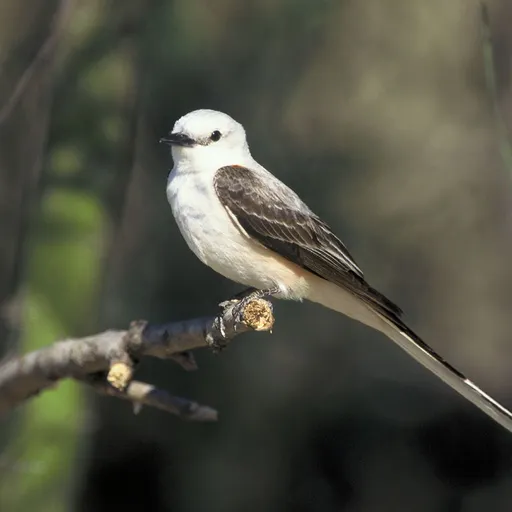
Scissor-tailed Flycatcher
Tyrannus forficatus
Least Concern
Overview
The scissor-tailed flycatcher, Tyrannus forficatus, is a long-tailed, insectivorous bird belonging to the genus Tyrannus, whose members are collectively known as kingbirds. It is classified as Least Concern on the IUCN Red List and is officially designated as the state bird of Oklahoma.
Identification
- Pale gray head and upper parts, light underparts, and salmon-pink flanks and undertail coverts.
- Extremely long, forked tail that is black on top and white on the underside; the male's tail may reach up to 38 cm in length, while the female's is up to 30% shorter.
- Dark gray wings with red axillars and a patch on the underwing coverts.
- Immature birds exhibit duller colours and possess shorter tails compared to adults.
Habitat
This species breeds in open shrubby country with scattered trees across the south-central United States, extending from Texas to Oklahoma, Kansas, and parts of Louisiana, Arkansas, Missouri, and New Mexico, as well as northeastern Mexico. Its winter non-breeding range spans from southern Mexico to Panama, with occasional stray visitors recorded as far north as southern Canada and New York.
Diet
During the summer, the bird feeds mainly on insects such as grasshoppers, robber-flies, and dragonflies, employing a hawking strategy where it waits on a perch before flying out to catch prey in flight. In the winter, its diet is supplemented with berries.
Did you know?
The bird's specific epithet, forficatus, derives from the Latin forfex, meaning "a pair of scissors", reflecting its distinctive tail shape. It is so closely related to the western kingbird that a hybrid breeding zone exists in eastern Arkansas and western Tennessee where the two species potentially compete for the same ecological niche.
Sources
- Wikipedia · CC BY-SA 4.0
- Wikidata · CC0 1.0