
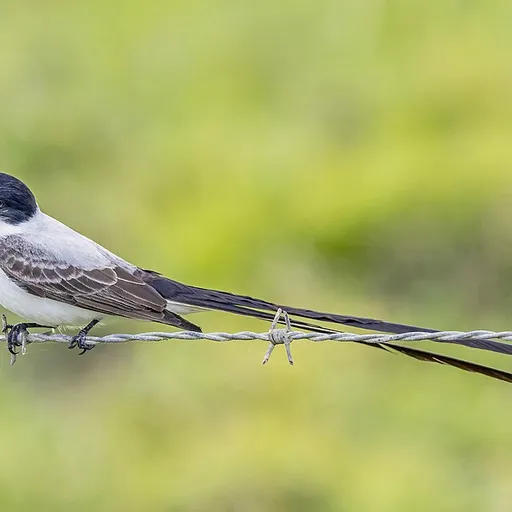
Fork-tailed Flycatcher
Tyrannus savana
Least Concern
Overview
The fork-tailed flycatcher (Tyrannus savana) is a passerine bird of the tyrant flycatcher family and a member of a genus typically referred to as kingbirds. Named for its long, forked tail, particularly in males, it ranges from southern Mexico to Argentina. The species is listed as Least Concern on the IUCN Red List.
Identification
- White below, grey above, with a black cap; males sometimes display a yellow crown stripe.
- Males possess an extremely long, forked tail, two to three times longer than the body length, while females and juveniles have significantly shorter tails.
- Males measure 37–41 cm in length, whereas females are 28–30 cm; both weigh only 28–32 g.
- Vocalisations include a dry, buzzy call, a weak 'tic-note' in flight, and a distinct whistling note produced by the wings.
Habitat
Found below 1000 m elevation, the species inhabits shrubland, savanna, grassland, riparian forests, forest edges, mangroves, and open residential areas with scattered trees. The breeding range extends from central Mexico to central Argentina, with northern populations often remaining year-round and southern populations migrating northward for winter.
Diet
Primarily insectivorous, the bird sallies from conspicuous perches to catch flying insects or gleans them from leaves and fruit. When insects are scarce in winter months, they have been observed eating fruits. The long tail allows for quick turns and stops in pursuit of flying prey, enabling speeds up to 105 km/h.
Did you know?
During mating displays, males' wings can produce dry, crackling sounds that may be used to startle predators or deter nest parasites such as shiny cowbirds. Males also perform aerial courtship displays involving swirling somersaults, twists, and flips accompanied by buzzing calls.
Sources
- Wikipedia · CC BY-SA 4.0
- Wikidata · CC0 1.0