
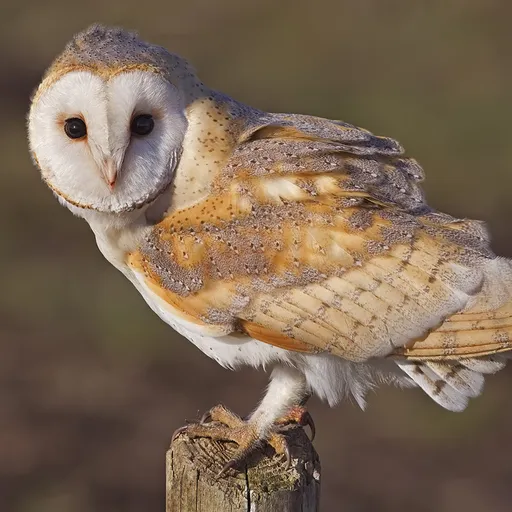
Western Barn Owl
Tyto alba
Least Concern
Listen
XC707104 · Sonothèque ADVL · Jullouville, Manche, Normandie, France · CC0 1.0
Overview
The western barn owl (Tyto alba) is a medium-sized, pale-coloured owl native to Europe, southwestern Asia, and Africa. It was formerly classified as a subspecies of a global barn owl group, but was split into a separate species due to genetic divergences.
Identification
- Plumage is mottled grey or brown on the head and back, with underparts varying from white to brown and often speckled with dark markings.
- Features a large, heart-shaped facial disc that is typically bright white, contrasting with black eyes and a bill that varies from pale horn to dark buff.
- Medium-sized with long wings and a short, squarish tail; flight is characterised by an effortless, undulating or wavering pattern.
- Does not hoot but produces an eerie, long-drawn-out shriek or piercing shree scream, and can hiss like a snake when threatened.
Habitat
This species prefers open country such as farmland or grassland with interspersed woodland, typically found below 2,000 metres but occasionally up to 3,000 metres in the tropics. Its range covers all of Europe except Fennoscandia and Malta, most of Africa apart from the Sahara, and southwest Asia east to western Iran.
Diet
Barn owls specialise in hunting ground-dwelling animals, relying on acute hearing to locate small mammals, which make up over 90% of their diet in moist temperate areas. They forage by flying slowly and quartering the ground, often hovering over potential prey, and may also use branches or posts as lookouts. While mostly specialist feeders in productive areas, they become generalists in drier regions, consuming a variety of creatures including birds, bats, lizards, and insects.
Did you know?
The western barn owl is considered one of the most economically valuable wildlife species for agriculture, as it consumes more rodents than possibly any other creature of its size. Farmers often find these owls more effective than poison in controlling rodent pests and can encourage their habitation by providing nest sites.
Sources
- Wikipedia · CC BY-SA 4.0
- Wikidata · CC0 1.0