
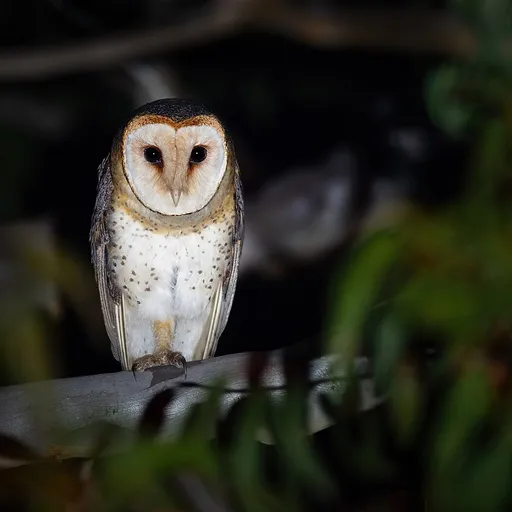
Australian Masked Owl
Tyto novaehollandiae
Least Concern
Overview
The Australian masked owl, Tyto novaehollandiae, is a species of barn owl found in Southern New Guinea and the non-desert areas of Australia. It is currently classified as Least Concern on the IUCN Red List, although mainland populations are declining and it is listed as threatened in some Australian states.
Identification
- Dorsal plumage is brown with light grey spots on the upper back, while the front is white with brown spots.
- A white, heart-shaped mask surrounds the eyes, which vary from black to dark brown.
- Females are larger and darker than males, with lengths ranging from 390 to 500 mm and weights up to 1,260 g, compared to male lengths of 330 to 410 mm.
- Tasmanian masked owls are the largest of the barn-owl family, with females reaching wingspans of up to 1,280 mm.
Habitat
This species inhabits timbered areas, often with a shrub understorey, and roosts and nests in large tree hollows near foraging areas. In Australia, they are seldom found more than 300 km inland, though some populations use caves or rock crevices for nesting.
Diet
The Australian masked owl forages primarily for terrestrial prey but may also take food from trees or in flight. Their diet includes rodents, small dasyurids, possums, bandicoots, rabbits, bats, birds, reptiles, and insects.
Did you know?
The Tasmanian subspecies is the largest member of the entire barn-owl family, with females averaging 845 g and exceeding the size of the greater sooty owl. A 2020 study suggested that home ranges for these owls might be as large as 19–23 km², though the data remains ambiguous due to the small sample size.
Sources
- Wikipedia · CC BY-SA 4.0
- Wikidata · CC0 1.0