
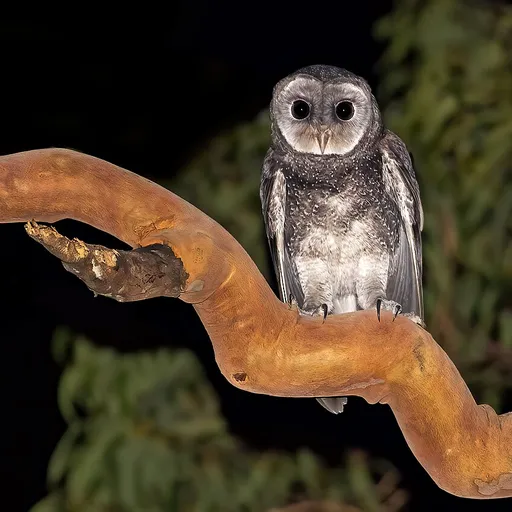
Greater Sooty Owl
Tyto tenebricosa
Least Concern
Overview
The greater sooty owl (Tyto tenebricosa) is a medium to large owl found in south-eastern Australia, the montane rainforests of New Guinea, and occasionally Flinders Island in the Bass Strait. It is currently classified as Least Concern on the IUCN Red List, though its conservation status varies by region within Australia.
Identification
- Females are 41–50 cm long and heavier than males, who measure 37–43 cm.
- The head features fine white spotting, while the upper body is black to dark gray and the underparts are lighter.
- A large, round facial disk is dark gray-silver or sooty black with a heavy black edge, containing large dark eyes.
- The call is a piercing shriek that can last up to two seconds, accompanied by distinctive rasps, screams, and a 'falling bomb' call.
Habitat
This species inhabits moist forests with deep gullies, smooth-barked gum trees, and tree ferns, where it roosts in large tree hollows, caves, or dense foliage during the day. Although they may hunt in drier areas, they typically breed and roost in moister environments.
Diet
Their diet consists primarily of mammals, ranging from large arboreal species like greater gliders to smaller rodents, bandicoots, and antechinus, with occasional consumption of birds, bats, and insects. Dietary habits have shifted post-colonisation, with a greater reliance on arboreal prey due to the reduction of terrestrial animal populations.
Did you know?
The greater sooty owl is considered the heaviest of the living species in the barn owl family, surpassing all others except the larger Tasmanian subspecies of the Australian masked owl.
Sources
- Wikipedia · CC BY-SA 4.0
- Wikidata · CC0 1.0