
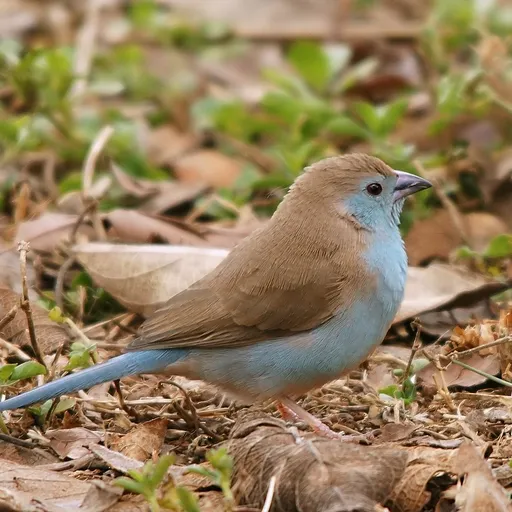
Blue Waxbill
Uraeginthus angolensis
Least Concern
Overview
The blue waxbill (Uraeginthus angolensis), also known as the southern blue waxbill, is a common estrildid finch native to Southern Africa. It is a small bird that is also relatively popular as an aviary species.
Identification
- Distinctive powder-blue face, breast, rump, and flanks contrasting with pale brown upperparts.
- Females are paler than males, with blue confined to the rump, tail, head, and upper breast, while the rest of the underparts are buffy brown.
- Measures 12–13 cm in length.
- Produces a soft 'seee-seee' call, often repeated as the bird moves through the lower parts of bush and scrub.
Habitat
Found across southern Africa from Cabinda and the Congo to Kenya and Tanzania in the east, and south to northern South Africa, with possible introductions to São Tomé and Zanzibar. The species generally prefers well-watered and semi-arid savanna, particularly where umbrella thorns grow, but also occupies natural growth in cultivated land, mopane woodlands, and forest edges.
Diet
Primarily feeds on grass seeds taken from inflorescences, supplemented by termites, other insects, and occasionally the fallen fruits of Boscia albitrunca. Birds are typically seen foraging in pairs or family parties, but will form larger flocks that often mix with other estrildid finches.
Did you know?
The blue waxbill often builds its nest near the nest of a wasp, such as Belonogaster juncea, not because the wasps deter predators, but likely to assess whether arboreal ants, which would deter nesting, are present in the tree.
Sources
- Wikipedia · CC BY-SA 4.0
- Wikidata · CC0 1.0