
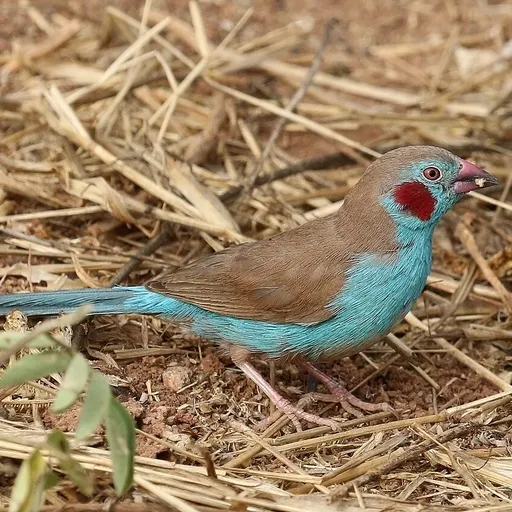
Red-cheeked Cordon-bleu
Uraeginthus bengalus
Least Concern
Listen
XC376080 · Anne Ndung'u · Nairobi, Nairobi County, Kenya · CC BY-SA 4.0
Overview
The red-cheeked cordon-bleu (Uraeginthus bengalus) is a small passerine bird in the family Estrildidae, recognised as a resident breeder in the drier regions of tropical Sub-Saharan Africa. It is a common and widespread species with a global extent of occurrence estimated at 7,700,000 km².
Identification
- A very small finch measuring 12.5–13 cm in length and weighing approximately 9.9 g.
- Adult males feature continuous blue coloration from the face to the breast, flanks, rump, and tail, contrasted with light brown wings and belly.
- A distinctive red patch on each cheek, which may rarely appear orange or yellow, distinguishes the adult male from duller females that lack this spot.
- The call is a thin, high-pitched piping transcribed as 'siii siii' or 'tsee tsee', while the song consists of 4–6 high-pitched notes ending in a lower, burry tone.
Habitat
Found across central and eastern Africa, stretching from Senegal and Mauritania east to Ethiopia and Somalia, and south to Tanzania and Mozambique. The species inhabits all environments except forest interiors, ranging in elevation from sea level to 2,430 m, with a preference for open dry grassland and savanna near human habitation. It has also been introduced to the Hawaiian Islands of Hawaii and Oahu.
Diet
The red-cheeked cordon-bleu is a granivore that feeds principally on grass seeds, along with millet and other small seeds. It is also known to feed sporadically on beeswax. Larger granivores, such as the pin-tailed whydah, may chase them from food sources, limiting foraging opportunities.
Did you know?
Unlike many other passerines, female red-cheeked cordon-bleus sing, producing less complex songs than males to help with pair bond maintenance or breeding synchronisation. The species was originally named Fringilla bengalus by Linnaeus based on the erroneous belief that the type specimen had been collected in Bengal, although the type location was later designated as Senegal.
Sources
- Wikipedia · CC BY-SA 4.0
- Wikidata · CC0 1.0