
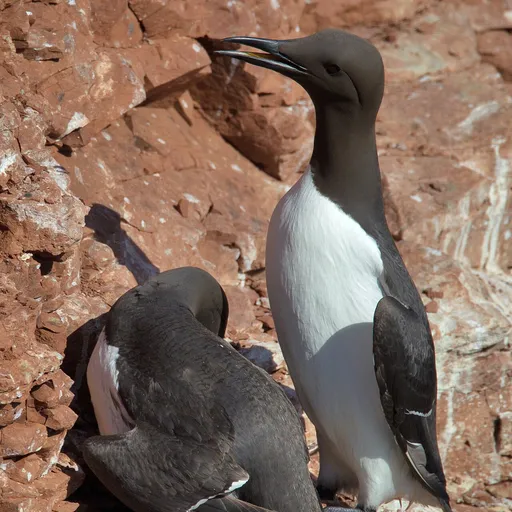
Common Murre
Uria aalge
Least Concern
Listen
XC1041354 · Sonothèque ADVL · Fréhel, Cotes-d'Armor, Brittany, France · CC0 1.0
Overview
The common murre, also known as the common guillemot (Uria aalge), is a large auk species found in circumpolar waters of the North Atlantic and North Pacific. It spends the majority of its life at sea, coming to land only to breed on rocky cliffs or islands, and is currently listed as Least Concern on the IUCN Red List.
Identification
- Plumage: In breeding plumage, the head, back, and wings are black (or dark brown in U. a. albionis), contrasting with white underparts; winter plumage features a white face with a dark spur behind the eye.
- Size: A large seabird measuring 38–46 cm in length with a 61–73 cm wingspan, with weights ranging from 775 g to 1,250 g depending on latitude.
- Bill and Legs: Possesses a thin, dark, pointed bill and dark grey legs, though occasional adults have been observed with yellow-grey legs or a bright yellow bill.
- Voice: The main adult call is a growling "murrrr" that can be deafening in large colonies, while chicks emit a high-pitched whistling "willee" to beg for food.
Habitat
Breeding habitats consist of islands, rocky shores, cliffs, and sea stacks where the birds nest in dense colonies known as "loomeries." While they occur in low-Arctic and boreal waters, northern populations migrate south to open waters near New England, southern California, Japan, and the western Mediterranean during winter, whereas some southern populations remain near breeding sites year-round.
Diet
Common murres are pursuit-divers that forage by 'flying' underwater, typically diving to depths of 30–60 m to capture small schooling forage fish such as capelin, sand lances, and polar cod. They also consume molluscs, marine worms, squid, and crustaceans like amphipods, carrying prey lengthways in their bill with the tail hanging out.
Did you know?
Common murres lay a single egg on a bare rock ledge without building a nest, and the egg's distinctive pyriform shape is hypothesised to improve stability on sloping surfaces, minimise impact damage from neighbours, and reduce drag during underwater swimming. Chicks must leap from cliff edges as high as 457 m to the sea below when they are just 20–22 days old, gliding with fluttering wings before being cared for by the father at sea.
Sources
- Wikipedia · CC BY-SA 4.0
- Wikidata · CC0 1.0