
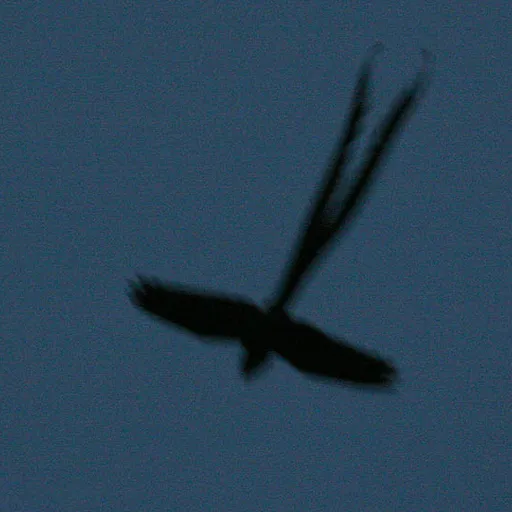
Lyre-tailed Nightjar
Uropsalis lyra
Least Concern
Listen
XC251730 · Niels Krabbe · Napo: km 11.6 Narupa-Loreto road, Ecuador · CC BY-SA 4.0
Overview
The lyre-tailed nightjar (Uropsalis lyra) is a species of nightjar in the family Caprimulgidae. It is found across parts of South America, including Argentina, Bolivia, Colombia, Ecuador, Peru, and Venezuela.
Identification
- Plumage: Males have extremely long outer tail feathers, more than twice the length of their body, while females have shorter, less graduated tails; upperparts are brown with grayish white, buff, tawny, and cinnamon spots and a broad tawny collar.
- Size: Adults of the nominate subspecies measure 23.5 to 28 cm in length excluding the tail streamers, with the tail exceeding 60 cm; males weigh about 70 g and females about 77 g.
- Markings: The chin and throat are tawny or buff with brown bars and spots, and the breast and upper belly are brown with dense tawny bars and spots.
- Song: The song consists of a rollicking series of 5-11 rising "wéeou-tee" notes, mostly sung at dusk from a perch or the ground, and a rapid series of "weep-weep-weep-weepupup" sounds during display flight.
Habitat
The species inhabits humid montane forest, favouring its edges, openings, cliffs, and ravines near running water. It mostly ranges in elevation from 1,100 to 2,100 m, but can occur as low as 800 m and as high as 3,500 m.
Diet
The lyre-tailed nightjar forages by sallying from a rock or low perch along the forest edge, usually returning to the same perch, and its diet is assumed to consist of insects similar to that of other nightjars.
Did you know?
Males display in flight to females at communal leks, and one well-studied nest was a scrape cleared of debris in an abandoned masonry fireplace in disturbed forest near pastureland.
Sources
- Wikipedia · CC BY-SA 4.0
- Wikidata · CC0 1.0