
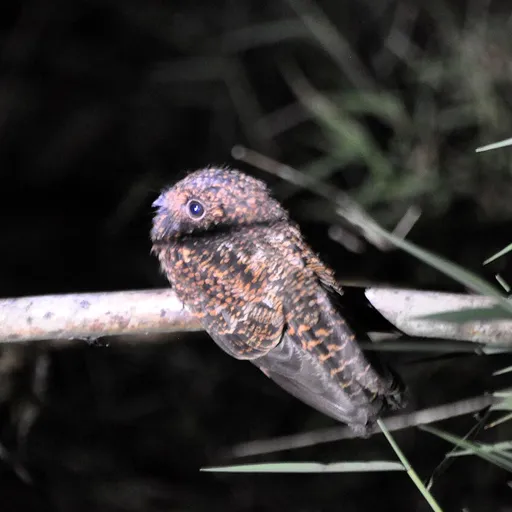
Swallow-tailed Nightjar
Uropsalis segmentata
Least Concern
Listen
XC251731 · Niels Krabbe · Zamora-Chinchipe: camp on Ventanilla-Christopher Parson trail, Reserva Tapichalaca, Ecuador · CC BY-SA 4.0
Overview
The swallow-tailed nightjar (Uropsalis segmentata) is a species of nightjar found in the Andean region of South America. It is classified as a species of Least Concern by the IUCN, with a stable population despite no immediate threats having been identified.
Identification
- Males possess extremely long outer tail feathers, making the bird approximately 66 cm long, whereas females have much shorter tails and measure around 23 cm.
- The upperparts are dark brown with tawny spots, and the wings are brown to greyish-brown with tawny spots.
- The song is described as an unmistakable, beautiful vibrating 'worr-r-r-e-e-e-e-e-r' that slides up and then drops down, accompanied by a liquid, rising 'pwip' when agitated.
Habitat
This bird inhabits the Andes of Bolivia, Colombia, Ecuador, and Peru, typically residing in elfin forest, the edges of humid montane forest, and openings with bamboo, grass, or shrubs. It occupies elevations ranging from 2,000 to 3,600 m across its range, though it may occur as low as 2,100 m in specific areas of Ecuador.
Diet
The swallow-tailed nightjar is crepuscular and nocturnal, foraging by sallying from the ground or a low perch, as well as during low continuous flight over open areas. Its diet consists of insects, though specific details regarding its prey have not been extensively studied.
Did you know?
Unlike many other nightjars that lay eggs on bare ground, the swallow-tailed nightjar constructs a nest as a depression in the ground lined with dried leaves and dead twigs.
Sources
- Wikipedia · CC BY-SA 4.0
- Wikidata · CC0 1.0