
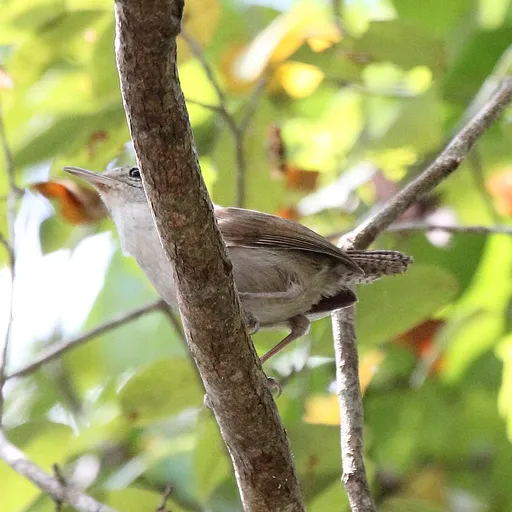
White-bellied Wren
Uropsila leucogastra
Least Concern
Overview
The white-bellied wren (Uropsila leucogastra) is a small bird belonging to the wren family Troglodytidae. It is currently classified as a species of Least Concern and is reasonably common across much of its range.
Identification
- Length of 9.5 to 10 cm with a medium brown crown, upperparts, and tail.
- A gray-white supercilium and gray cheeks mottled with brown.
- Throat, chest, and upper belly are gray, while flanks and vent area are buff.
- Song is a short series of six rapid up-and-down notes that descend at the end.
Habitat
Inhabits a variety of woodland types, ranging from the semi-arid forests of western Mexico to the humid rainforests of the Yucatan Peninsula, at elevations from sea level to 500 m. Its range spans western and northeastern Mexico, the Yucatan Peninsula, Belize, Guatemala, and northern Honduras.
Diet
Forages for insects and spiders in vegetation from ground level to considerable height. In the southern part of its range, it frequently joins mixed-species flocks that follow army ant swarms.
Did you know?
Its nest is shaped like a chemical retort, an oval ball with a downward pointing funnel entrance, usually woven from fine grass and decorated with lichens and moss in spiny locations.
Sources
- Wikipedia · CC BY-SA 4.0
- Wikidata · CC0 1.0